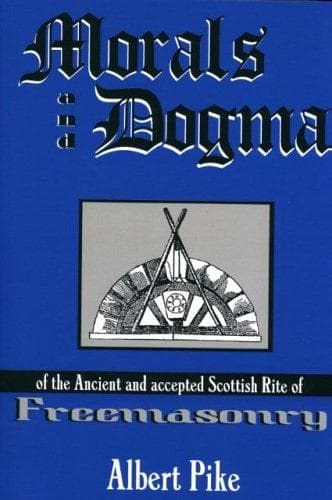
Morals and Dogma of the Ancient and Accepted Scottish Rite of FreemasonryPike, Albert
Religion
Morals and Dogma of the Ancient and Accepted Scottish Rite of Freemasonry
Pike, Albert
Freemasons
It is quite true that the advance of humanity is slow, and that it often
pauses and retrogrades. In the kingdoms of the earth we do not see
despotisms retiring and yielding the ground to self-governing
communities. We do not see the churches and priesthoods of Christendom
relinquishing their old task of governing men by imaginary terrors.
Nowhere do we see a populace that could be safely manumitted from such a
government. We do not see the great religious teachers aiming to
discover truth for themselves and for others; but still ruling the
world, and contented and compelled to rule the world, by whatever dogma
is already accredited; themselves as much bound down by this necessity
to govern, as the populace by their need of government. Poverty in all
its most hideous forms still exists in the great cities; and the cancer
of pauperism has its roots in the hearts of kingdoms. Men there take no
measure of their wants and their own power to supply them, but live and
multiply like the beasts of the field,--Providence having apparently
ceased to care for them. Intelligence never visits these, or it makes
its appearance as some new development of villainy. War has not ceased;
still there are battles and sieges. Homes are still unhappy, and tears
and anger and spite make hells where there should be heavens. So much
the more necessity for Masonry! So much wider the field of its labors!
So much the more need for it to begin to be true to itself, to revive
from its asphyxia, to repent of its apostasy to its true creed!
Undoubtedly, labor and death and the sexual passion are essential and
permanent conditions of human existence, and render perfection and a
millennium on earth impossible. Always,--it is the decree of Fate!--the
vast majority of men must toil to live, and cannot find time to
cultivate the intelligence. Man, knowing he is to die, will not
sacrifice the present enjoyment for a greater one in the future. The
love of woman cannot die out; and it has a terrible and uncontrollable
fate, increased by the refinements of civilization. Woman is the
veritable syren or goddess of the young. But society can be improved;
and free government is possible for States; and freedom of thought and
conscience is no longer _wholly_ utopian. Already we see that Emperors
prefer to be elected by universal suffrage; that States are conveyed to
Empires by vote; and that Empires are administered with something of the
spirit of a Republic, being little else than democracies with a single
head, ruling through one man, one representative, instead of an assembly
of representatives. And if Priesthoods still govern, they now come
before the laity to prove, by stress of argument, that they _ought_ to
govern. They are obliged to evoke the very reason which they are bent on
supplanting.
Public-domain text, read in full here on John Shaqi.
Reviews
Reviews
No reviews yet
Be the first to share your thoughts on this work.
Elsewhere in the archive
Join the Discussion
Join the discussion
Sign in to leave a comment or review.
Sign InorCreate an account