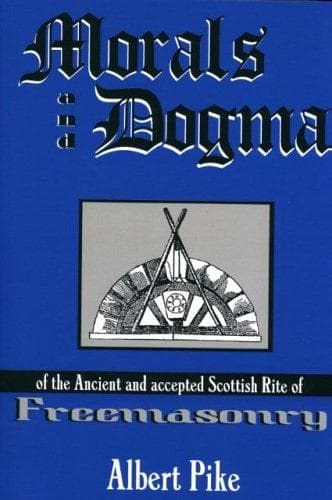
Morals and Dogma of the Ancient and Accepted Scottish Rite of FreemasonryPike, Albert
Religion
Morals and Dogma of the Ancient and Accepted Scottish Rite of Freemasonry
Pike, Albert
Freemasons
Accordingly, men become daily more free, because the freedom of the man
lies in his reason. He can reflect upon his own future conduct, and
summon up its consequences; he can take wide views of human life, and
lay down rules for constant guidance. Thus he is relieved of the tyranny
of sense and passion, and enabled at any time to live according to the
whole light of the knowledge that is within him, instead of being
driven, like a dry leaf on the wings of the wind, by every present
impulse. Herein lies the freedom of the man as regarded in connection
with the necessity imposed by the omnipotence and fore-knowledge of God.
So much light, so much liberty. When emperor and church appeal to reason
there is naturally universal suffrage.
Therefore no one need lose courage, nor believe that labor in the cause
of Progress will be labor wasted. There is no waste in nature, either of
Matter, Force, Act, or Thought. A Thought is as much the end of life as
an Action; and a single Thought sometimes works greater results than a
Revolution, even Revolutions themselves. Still there should not be
divorce between Thought and Action. The true Thought is that in which
life culminates. But all wise and true Thought produces Action. It is
generative, like the light; and light and the deep shadow of the passing
cloud are the gifts of the prophets of the race. Knowledge, laboriously
acquired, and inducing habits of sound Thought,--the reflective
character,--must necessarily be rare. The multitude of laborers cannot
acquire it. Most men attain to a very low standard of it. It is
incompatible with the ordinary and indispensable avocations of life. A
whole world of error as well as of labor, go to make one reflective
man. In the most advanced nation of Europe there are more ignorant than
wise, more poor than rich, more automatic laborers, the mere creatures
of habit, than reasoning and reflective men. The proportion is at least
a thousand to one. Unanimity of opinion is so obtained. It only exists
among the multitude who do not think, and the political or spiritual
priesthood who think for that multitude, who think how to guide and
govern them. When men begin to reflect, they begin to differ. The great
problem is to find guides who will not seek to be tyrants. This is
needed even more in respect to the heart than the head. Now, every man
earns his special share of the produce of human labor, by an incessant
scramble, by trickery and deceit. Useful knowledge, honorably acquired,
is too often used after a fashion not honest or reasonable, so that the
studies of youth are far more noble than the practices of manhood. The
labor of the farmer in his fields, the generous returns of the earth,
the benignant and favoring skies, tend to make him earnest, provident,
and grateful; the education of the market-place makes him querulous,
crafty, envious, and an intolerable niggard.
Public-domain text, read in full here on John Shaqi.
Reviews
Reviews
No reviews yet
Be the first to share your thoughts on this work.
Elsewhere in the archive
Join the Discussion
Join the discussion
Sign in to leave a comment or review.
Sign InorCreate an account