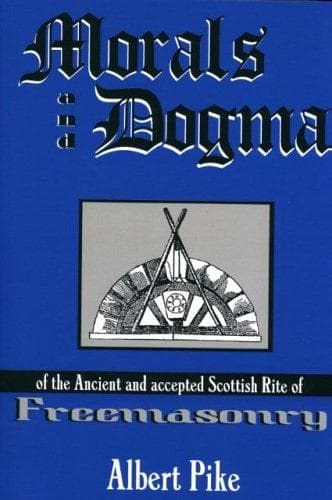
Morals and Dogma of the Ancient and Accepted Scottish Rite of FreemasonryPike, Albert
Religion
Morals and Dogma of the Ancient and Accepted Scottish Rite of Freemasonry
Pike, Albert
Freemasons
Plato, writing to Dionysius the Younger, in regard to the nature of the
First Principle, says: "I must write to you in enigmas, so that if my
letter be intercepted by land or sea, he who shall read it may in no
degree comprehend it." And then he says, "All things surround their
King; they are, on account of Him, and He alone is the cause of good
things, Second for the Seconds and Third for the Thirds."
There is in these few words a complete summary of the Theology of the
Sephiroth. "The _King_" is AINSOPH, Being Supreme and Absolute. From
this centre, _which_ is _everywhere_, all things ray forth; but we
especially conceive of it in three manners and in three different
spheres. In the _Divine_ world (AZILUTH), which is that of the First
Cause, and wherein the whole Eternity of Things in the beginning existed
as Unity, to be afterward, during Eternity uttered forth, clothed with
form, and the attributes that constitute them matter, the First
Principle is Single and First, and yet not the VERY Illimitable Deity,
incomprehensible, undefinable; but Himself in so far as manifested by
the Creative Thought. To compare littleness with infinity,--Arkwright,
as inventor of the spinning-jenny, and not the _man_ Arkwright
_otherwise_ and _beyond that_. All we can know of the Very God is,
compared to His Wholeness, only as an infinitesimal fraction of a unit,
compared with an infinity of Units.
In the World of Creation, which is that of Second Causes [the Kabalistic
World BRIAH], the Autocracy of the First Principle is complete, but we
conceive of it only as the Cause of the Second Causes. Here it is
manifested by the Binary, and is the Creative Principle passive.
Finally: in the third world, YEZIRAH, or of Formation, it is revealed in
the perfect Form, the Form of Forms, the World, the Supreme Beauty and
Excellence, the Created Perfection. Thus the Principle is at once the
First, the Second, and the Third, since it is All in All, the Centre and
Cause of all. It is not _the genius of Plato_ that we here admire. We
recognize only _the exact knowledge of the Initiate_.
The great Apostle Saint John did not borrow from the philosophy of Plato
the opening of his Gospel. Plato, on the contrary, drank at the same
springs with Saint John and Philo; and John in the opening verses of his
paraphrase, states the first principles of a dogma common to many
schools, but in language especially belonging to Philo, whom it is
evident he had read. The philosophy of Plato, the greatest of human
Revealers, could _yearn toward_ the Word made man; the Gospel alone
could give him to the world.
Public-domain text, read in full here on John Shaqi.
Reviews
Reviews
No reviews yet
Be the first to share your thoughts on this work.
Elsewhere in the archive
Join the Discussion
Join the discussion
Sign in to leave a comment or review.
Sign InorCreate an account