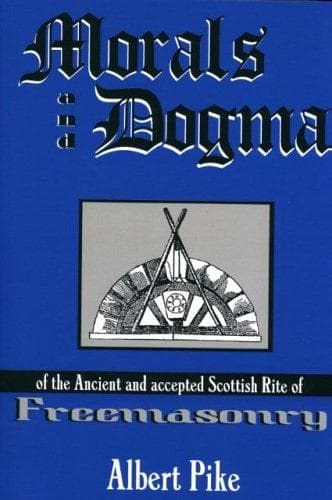
Morals and Dogma of the Ancient and Accepted Scottish Rite of FreemasonryPike, Albert
Religion
Morals and Dogma of the Ancient and Accepted Scottish Rite of Freemasonry
Pike, Albert
Freemasons
Being, Existence, is by itself, and because it Is. The reason of Being,
is Being itself. We may inquire, "Why does something exist?" that is,
"Why does such or such a thing exist?" But we cannot, without being
absurd, ask, "Why Is Being?" That would be to suppose Being before
Being. If Being had a cause, that cause would necessarily Be; that is,
the cause and effect would be identical.
Reason and science demonstrate to us that the modes of Existence and
Being balance each other in equilibrium according to harmonious and
hierarchic laws. But a hierarchy is synthetized, in ascending, and
becomes ever more and more monarchial. Yet the reason cannot pause at a
single chief, without being alarmed at the abysses which it seems to
leave above this Supreme Monarch. Therefore it is silent, and gives
place to the Faith it adores.
What is certain, even for science and the reason, is, that the idea of
God is the grandest, the most holy, and the most useful of all the
aspirations of man; that upon this belief morality reposes, with its
eternal sanction. This belief, then, is in humanity, the most real of
the phenomena of being; and if it were false, nature would affirm the
absurd; nothingness would give form to life, and God would at the same
time be and not be.
It is to this philosophic and incontestable reality, which is termed The
Idea of God, that the Kabalists give a name. In this name all others are
contained. Its cyphers contain all the numbers; and the hieroglyphics of
its letters express all the laws and all the things of nature.
BEING is BEING: the reason of Being is in Being: in the Beginning is the
Word, and the Word in logic formulated Speech, the spoken Reason; the
Word is in God, and is God Himself, manifested to the Intelligence. Here
is what is above all the philosophies. This we must believe, under the
penalty of never truly knowing anything, and relapsing into the absurd
skepticism of Pyrrho. The Priesthood, custodian of Faith, wholly rests
upon this basis of knowledge, and it is in its teachings we must
recognize the Divine Principle of the Eternal Word.
Light is not Spirit, as the Indian Hierophants believed it to be; but
only the instrument of the Spirit. It is not the body of the
Protoplastes, as the Theurgists of the school of Alexandria taught, but
the first physical manifestation of the Divine afflatus. God eternally
creates it, and man, in the image of God, modifies and seems to multiply
it.
The high magic is styled "The Sacerdotal Art," and "The Royal Art." In
Egypt, Greece, and Rome, it could not but share the greatnesses and
decadences of the Priesthood and of Royalty. Every philosophy hostile to
the national worship and to its mysteries, was of necessity hostile to
the great political powers, which lose their grandeur, if they cease, in
the eyes of the multitudes, to be the images of the Divine Power. Every
Crown is shattered, when it clashes against the Tiara.
Public-domain text, read in full here on John Shaqi.
Reviews
Reviews
No reviews yet
Be the first to share your thoughts on this work.
Elsewhere in the archive
Join the Discussion
Join the discussion
Sign in to leave a comment or review.
Sign InorCreate an account