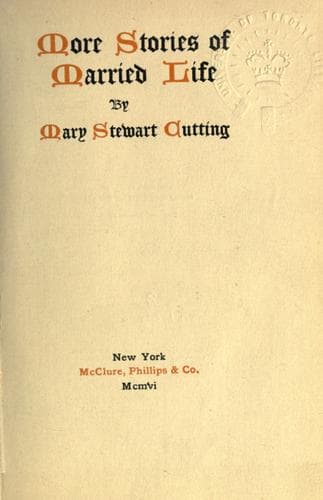
Married people -- United States -- Fiction; United States -- Social life and customs -- 20th century -- Fiction
“Yes,” said Mrs. Stannard again. She sat there, a small, unpretending
figure in her black gown, very fair and young looking in the dingy office
surroundings. She was twisting the white envelope in her fingers, the
weapon that George had unwittingly left her that she was to wield in
behalf of his son—if she wanted to.
“We have missed George a great deal in these last two years,” said Nelson
with a change of tone, and an obvious effort of recollection. “Nobody
had the interest in the firm that he had, Mrs. Stannard. His only fault
was that he was not quite up to date in matters of management; he was
a splendid organizer, but he let his feelings run away with him too
much. This recognizing individual ability is all very well in its way,
but if you are going in to make money the interests of the house must
come first. George never could drive a really sharp bargain—I don’t mind
saying it, Mrs. Stannard, for he owned it himself—and it was a credit to
his heart, of course—he could not keep up to date in that way. The modern
methods of business require _tremendous_ concentration of purpose. White
and I”—he glanced at White, who stood near him, gazing seriously at the
visitor—“have been quite worn out with our efforts lately, but we have
been very successful. Of three firms who were in competition with us at
the beginning of the year, two have broken up and had to give in to our
terms already, and the third will before long. It’s a pretty fair record.
George’s only fault—and that was a credit to his heart—was that he was
not good at such transactions, he let his feelings run away with him.”
“Yes, that was his only fault,” said White.
Oh, if they only would not speak of George! She suddenly felt that it was
the one thing she could not bear.
“How is your wife, Mr. Nelson?” she asked hurriedly.
“My wife? She was well when I last heard from her. She and the children
have been in Dresden—she is there for their education, you know—expects
to be gone three years.”
“It must be very lonely for you. Why don’t you go over, too?” she
hazarded.
“Work, work! That’s what keeps me here. I give you my word, Mrs.
Stannard, the business is so immense now, the operations of the house so
large, that I can hardly take even a day off. Here’s White trying to get
away to his sick boy up in Minnesota for a couple of weeks, and yet we
can’t see how to manage it, just at this time, without losing the firm a
deal that will give us enormous profit.”
“Is your boy ill?” asked Mrs. Stannard, turning sympathetically to White.
His only child was the age of her Francis.
White nodded, with his boyish face suddenly turned grey and haggard, like
that of an old, old man.
Public-domain text, read in full here on John Shaqi.
Reviews
Reviews
No reviews yet
Be the first to share your thoughts on this work.
Elsewhere in the archive
Join the Discussion
Join the discussion
Sign in to leave a comment or review.
Sign InorCreate an account