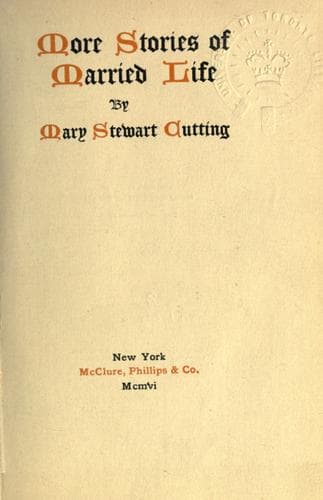
Married people -- United States -- Fiction; United States -- Social life and customs -- 20th century -- Fiction
“He—he’s crippled,” he answered. “He had a bad fall. Didn’t you hear?
Hurt himself racing. The doctors give us some hope, there’s no immediate
danger, but his strength seems to be going. That’s the main point, you
know—strength. I’ve thought if I could get up to Minnesota just now, to
help his mother—— But I can’t seem to make it out Of course, business
comes first.”
“God _help_ you, Harry!” said Mrs. Stannard, softly. She had risen and he
stretched out his hand and took hers in it, and held it for a moment in a
tight grip, with his head turned away.
“You were always good, Clara,” he said huskily. “I hope He will.”
“You have dropped your letter,” said Nelson, coming forward. “Or perhaps
you do not want it?”
“Thank you,” said Mrs. Stannard. “No, I do not want it now.” Send Francis
here, where if he would be successful he must learn to fight against
every impulse of his higher nature? What would his father have said? She
tore the paper into small pieces with fingers that were firmly tense.
“May I put these in your scrap basket? I know that I have taken up too
much of your time, Mr. Nelson, I will say good-bye.”
“I am glad to have seen you, Mrs. Stannard,” he said. He looked at his
partner, who stood, turned from them, his arms resting on the tall desk,
and his head buried in them, and then looked back again at her. She made
a movement of comprehension, and slipped quietly out of the door, and
pulling her veil quickly over her face, went down the long stairs again
that her husband had been wont to traverse, feeling that the dear form
was somehow at her side. But she saw nothing, for her eyes were blinded
by tears, not for White’s sorrow, not for her husband’s death, but for
another and irremediable loss; tears that overflowed and ran down her
cheeks, and seemed to keep welling up exhaustlessly from her heart; tears
from a pity so deep that it had its source in every happiness of high
thought and noble aim and unselfish love that had made her life.
No need to break her faith with the dead! She would not have her boy back
in that house of corruption, for all the gifts of Fortune. No need, no
need, for her to strike at the name of the firm! That name, so loved, so
honoured, slaved for, died for—God in heaven, for _what_ did the Name of
the Firm stand?
Public-domain text, read in full here on John Shaqi.
Reviews
Reviews
No reviews yet
Be the first to share your thoughts on this work.
Elsewhere in the archive
Join the Discussion
Join the discussion
Sign in to leave a comment or review.
Sign InorCreate an account