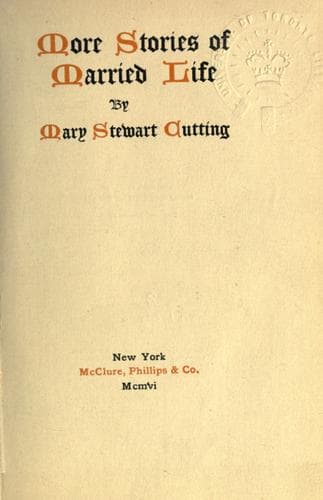
Married people -- United States -- Fiction; United States -- Social life and customs -- 20th century -- Fiction
“I don’t care for anything to eat. Don’t let the fire out,” she dictated
rapidly. “See that Harold doesn’t get uncovered, and _don’t_ bolt the
front door. We’ll be home before twelve, but you needn’t sit up for us.
Just lie on the lounge in the nursery.” She did not remind forgetful Katy
to put the milk tickets in the pail set outside the back door, and only
remembered it as she was half-way to the station.
The train was due in town at eight-five, but it was late here, and
the extra ten minutes seemed a thousand “prickly seconds.” The spring
twilight was coming to a close, and when she stepped into the car in
which the lamps gleamed dully over the plush seats, it was like stepping
into the long tunnel of the night. Only a few men from further up the
road sprawled and dozed wearily on their way. She was unaccustomed to
going out thus alone, and for an instant a panic-struck thought of
failure seized her, but she lost it in the action of her hurrying brain,
which constantly pictured the delightful meeting with her expectant
husband and the waiting party. By the inalienable law of travel, which
ordains that delay in one mode of locomotion means delay in every
other, the ferry-boat could not “hit her slip,” but wobbled up and down
crosswise in the current, bumping against the piles at either end, with
much ringing of the pilot’s bell, and losing of minutes—and minutes—and
minutes. But at last Mrs. Gibbons made her way into the big, lighted
waiting-room, the haven of her hopes. It took no more than one glance
to reveal that there was neither group nor husband waiting for her. The
place was entirely empty, save for a few Italian emigrants, and the clock
pointed to twenty minutes of nine.
So vividly had Mrs. Gibbons pictured her own state of mind as that of her
husband—a habit of which fell experience could not break her—that even in
the shock of not finding him she felt instantly that some provision had
been made for this contingency. She could go straight over and join the
party at Martin’s, but he might have left some word for her. The man at
the news stand might know. She hovered uncertainly around the pictorial
exhibit, trying to screw up a suddenly-waning courage, and then found
voice to say engagingly:
“I’m looking for my husband.”
“What did you say, lady?” The man stopped in his work of sorting papers.
“I’m looking for my husband. He’s been waiting for me here for a long
time—with a party—but he’s gone now. I thought perhaps he had left some
message here with you.”
“What kind of looking man was he?” asked the news clerk. He leaned
forward companionably.
“He—he’s tall, and clean shaven, with a light overcoat, and blue
eyes—and——” She groped around for some distinguishing characteristic to
elicit a gleam of response—“a square chin—with a dimple in it.” She felt
her own fatuousness. “You—you’d know him if you saw him.”
The clerk turned to a boy who had appeared behind the counter.
Public-domain text, read in full here on John Shaqi.
Reviews
Reviews
No reviews yet
Be the first to share your thoughts on this work.
Join the Discussion
Join the discussion
Sign in to leave a comment or review.
Sign InorCreate an account