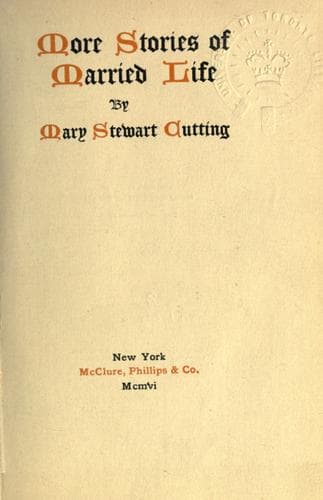
Married people -- United States -- Fiction; United States -- Social life and customs -- 20th century -- Fiction
He steadied her where she stood panting and breathless, looking down
at the top of her light-blue _chiffon_ hat, which had rather a pale
and chilly early-morning effect in connection with a tight-fitting tan
jacket. In lieu of furs she wore a white, pink-flowered silk scarf tied
around her throat, the long fringed ends depending below her waist.
Her figure was that of a young girl, but when she raised her small,
long-chinned face you saw that she was considerably older; there were
innumerable fine wrinkles around her pretty eyes—which had a soft haze
over them, as if she had cried a great deal—and her abundant fair hair
seemed a shade or two lighter than any nature could have intended it.
She had an indescribable effect of artificiality counteracted rather
appealingly by something bright and courageous in her gaze. Opinion
halted about Mrs. Lalor, who, as a Southern woman was not only alien in
habit to the Northern community to which she had lately come, but was
also looked upon debatingly by the small society of Southerners in the
place, usually hospitably ready to welcome any one from home.
It was unquestionable that she came of a good family, which counted for
very much, but it was rumoured that she had married against the family
wishes. No one knew anything of Mr. Lalor—who, in appearance, was a
tall, handsome man with a drooping, reddish-brown mustache—except that
he was unpleasingly dissipated and always in difficulties; it seemed to
discredit his wife in some way that she lived with him. She had, besides
a little flirting, attractive manner to men, a sort of an echo of past
belleship, which might have been all right if she had a nice husband, but
was felt to be a little stepping over the line when she hadn’t. A few
women averred that there was something in her that they really liked, of
whom tender-hearted little Mrs. Ramsey was one, and her neighbour, Mrs.
Laurence another. The latter was by nature both generous and romantic,
and with an unselfish, intelligent insight into lives that were different
from her own.
There was a trustfulness in Mrs. Lalor’s attitude now which appealed to
Laurence. He let go his hold of her as the wind subsided, to say:
“What are you out so early for this bitter morning? I’m just on my way to
your house. Is Lalor in?”
“If you were going for those papers”—Mrs. Lalor began tugging at the
breast of her jacket for a visible package—“My husband meant to bring
them around last night, but he’s in bed—with a cold.” Every one knew what
Mr. Lalor’s “colds” implied. “I thought you might need them to-day; I
was so afraid I wouldn’t catch you in time.” She drew a sharp breath that
showed how she had been hurrying.
“It was awfully good of you,” said Mr. Laurence warmly, as they turned
down another street together. “Lalor will be well enough to be seen this
evening, I hope?”
Public-domain text, read in full here on John Shaqi.
Reviews
Reviews
No reviews yet
Be the first to share your thoughts on this work.
Join the Discussion
Join the discussion
Sign in to leave a comment or review.
Sign InorCreate an account