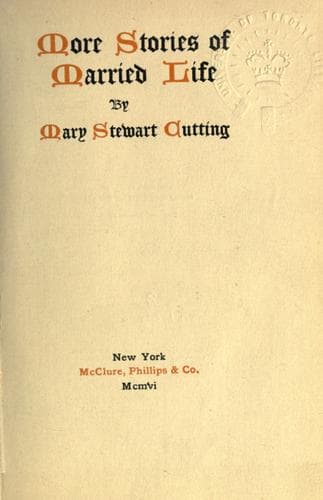
Married people -- United States -- Fiction; United States -- Social life and customs -- 20th century -- Fiction
“Yes, but I will speak of it!” Mrs. Townsend hurled herself into the
fray. “Francis, I can’t help it! When I think of all you’ve suffered, and
all you’ve done, and how much depends now on—oh, my dearest!” she tried
to put her head on an eluding shoulder as she followed him around the
room, flushed with her eloquence—“please take this money. If you knew how
happy I’d been all the time to think that I was working for you, and how
I had set my heart on it, you wouldn’t be so unkind. I know I told you my
shoes were bad, but they do quite well as they are, and the children do
not need warm underwear yet. It was very stupid of me to talk of it, and
it will make all the difference how you are dressed when you go to see
Mr. Effingham. You’ve often said what a difference a person’s appearance
made—and it’s so unlike you to look shabby! You ought to do everything
to try and get that position; you can’t afford to lose the ghost of a
chance. You are so foolish, you won’t listen to reason! Oh, Francis,
won’t you stand still and answer me?”
“Yes, I’ll answer you,” said Mr. Townsend deliberately. “You can
‘reason,’ as you call it, until you’re blind. Once for all, I will never
take that money.”
“You will.”
“I will not. Now, Polly not another word; do you hear? Not another word!”
“Very well,” said Mrs. Townsend, as before with conventional obedience,
and followed the words with a reckless flash of her grey eyes as she left
the room, murmuring with quick breath: “But I give you fair warning, I’ll
make you take that money yet; I don’t care whether you’re angry or not.
You’ll see, you’ll see!”
If the subject was dropped from speech afterwards it was nevertheless
present in thought. Mr. Townsend rose late in the morning, as is the
habit of the man “out of a position,” who has no place on the early
trains into town with his customary confrères, the workers, or in their
busy offices. The heads of departments whom he goes in to see are only
accessible in the later hours, and a delayed breakfast obviates the
necessity for luncheon. When husband and wife parted, he in the trousers
that were a good deal too short and a good deal too worn, she, indeed,
broke through the ice with temerity to adjure him for goodness sake not
to let any one see him to-day with those on, and he had retorted grimly
that he would endeavour to keep his hundred and eighty pounds entirely
invisible to oblige her.
Public-domain text, read in full here on John Shaqi.
Reviews
Reviews
No reviews yet
Be the first to share your thoughts on this work.
Elsewhere in the archive
Join the Discussion
Join the discussion
Sign in to leave a comment or review.
Sign InorCreate an account