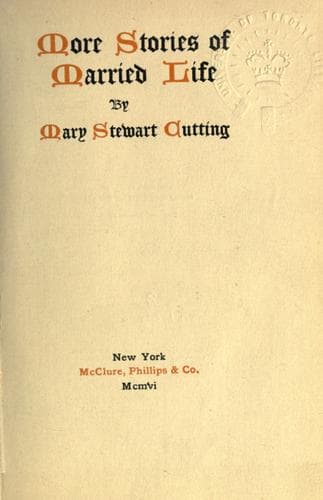
Married people -- United States -- Fiction; United States -- Social life and customs -- 20th century -- Fiction
During the course of the morning Mrs. Townsend went around with knitted
brows, pondering deeply over the vexed question. Her back ached and
her feet were weary long before her household labours were ended. She
wasn’t accustomed to doing her own work, and, though she was willing,
experience, that time-saver, was not hers. Mrs. Townsend knew that ladies
were popularly supposed to bring a deftness and daintiness to kitchen
work that was lacking in the efforts of a rougher class, but for herself
it was just the opposite. The scalding kettles and saucepans she carried
would perform a tremolo movement with the shaking of her slight wrists
that sent greasy splashes of the contents over the kitchen floor; the
beef-steak she broiled took in not only the fire but the whole top of the
range in its sputterings, and plates and dishes, whether empty or filled
with food for the table, slipped from her tired fingers and broke with
ruinous celerity. After all the ceaseless effort of her heroic incapacity
she was forced to long for the look of shining cleanliness accomplished
easily by the strong, accustomed arms of an ordinary “girl.”
And the children were going half-clothed, she had so little time to
sew! If this sort of thing didn’t stop soon she didn’t know what would
become of them all. Depression had grown to be her usual frame of mind
in the morning when there was no one to look at her. She had known that
Francis couldn’t get a place when he was so shabby. People were afraid
of men who looked poor; it seemed as if they couldn’t be capable. In
spite of himself she must save him, though he hurled javelins at her
afterwards. She would have gone and bought him the trousers out of hand
if remembrance had not brought uncomfortably to mind a time when she had
tried to demonstrate how economically she could regulate his smoking
by purchasing an advertized box of cigars from a department store. To
Polly Townsend, if you did a certain thing one certain effect ought to
follow—that, instead, it ramified off into all sorts of different ways
was the mean advantage life took over theory. She felt now that if she
could only make her Francis buy those trousers he couldn’t help realizing
gratefully afterwards how wise and good she’d been, and her heart glowed
at the prospect.
But Mr. Effingham! He was a man whose old-fashioned punctiliousness was
notably affected by externals: by suitable dress, by polish of manner,
by a certain air in addition to more solid requirements. It was bad
enough for Francis to hand the plate in those hideous, old, faded, mended
trousers, but to go supplicantly in them to Mr. Effingham would be
suicidal. She could have wept at the thought.
Public-domain text, read in full here on John Shaqi.
Reviews
Reviews
No reviews yet
Be the first to share your thoughts on this work.
Elsewhere in the archive
Join the Discussion
Join the discussion
Sign in to leave a comment or review.
Sign InorCreate an account