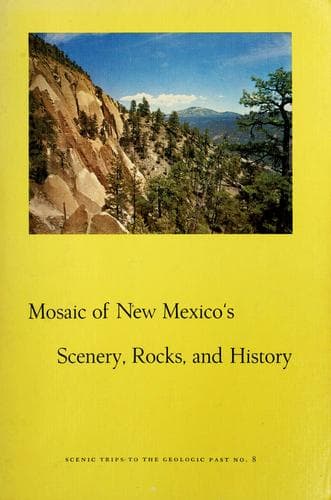
Mosaic of New Mexico's Scenery, Rocks, and History
History
Mosaic of New Mexico's Scenery, Rocks, and History
Geology -- New Mexico; New Mexico -- Description and travel; New Mexico -- History
All the fish imported are classed as game fish except carp and tench
(the latter did not survive). The various species met their habitat
requirements, and although there were no survivals in some locations,
they did acclimate in others and have developed into a substantial
fishery. Some species are predominant while others, like the rock bass,
are remnant and taken only occasionally. The fish most sought now and
predominant in the fishery are rainbow (fig. 2) and brown trout,
catfish, largemouth bass, crappie, and walleyed pike.
[Illustration: Figure 2. Joy of the fisherman, rainbow trout]
Management of the fishery has progressed with technical development.
When fish were planted in early years, very little thought was given
about the habitat except that it was water. There was little known of
the requirements of fish. As a result, fish were placed in waters only
to perish. To maintain a fish population now, all techniques available
are employed and fish are stocked where water and species are
compatible.
Water in the desert is always at a premium for the inhabitants. The
early Indian cultures used water for irrigation, and there are still
vestiges of canals used by Indians to convey water to their crops. The
use of water by the Indians then had little or no effect on fish life,
but as irrigation development increased, a new habitat was formed. The
once free-flowing rivers became dry in places, and new waters were
developed in the drainage ditches in the Rio Grande Valley. The
competition for water is very keen and fish and wildlife uses come after
domestic, commercial, and irrigation purposes.
The water requirements are so great, in fact, that it has been necessary
to control water and its use by laws. The law of 1876 provided that
water could not be refused a traveler. Community ditch commissioners
were established by law in 1895. The basic laws governing water rights
were established in 1907. These laws have been amended or added to as
conditions dictate. Conservancy districts were recognized by law in
1927, and underground waters came under law in 1931. The Interstate
Stream Commission was created in 1935. At present, New Mexico water laws
are considered some of the best in the nation; however, it has been only
recently that water for fish and wildlife has been recognized as one of
the beneficial uses.
Converse to the use of water to the detriment of fish and wildlife,
there are several areas in which water has been developed and impounded
to the benefit of the fishery. Although some impoundments were
single-purpose developments, they supply habitat in conservation pools
or during years of abundant water supply.
[Illustration: Figure 3. Find the elephant!—at Elephant Butte
reservoir]
Public-domain text, read in full here on John Shaqi.
Reviews
Reviews
No reviews yet
Be the first to share your thoughts on this work.
Elsewhere in the archive
Join the Discussion
Join the discussion
Sign in to leave a comment or review.
Sign InorCreate an account