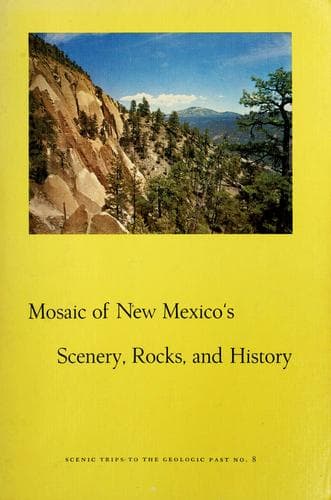
Mosaic of New Mexico's Scenery, Rocks, and History
History
Mosaic of New Mexico's Scenery, Rocks, and History
Geology -- New Mexico; New Mexico -- Description and travel; New Mexico -- History
Waters impounded by man but used as a fishery are Elephant Butte
Reservoir (fig. 3), 40,096 surface acres when full. It contains
largemouth black bass, crappie, walleyed pike, catfish, and sunfish.
This lake has not been full for many years; but like Alamogordo
Reservoir (4650 surface acres), Caballo Reservoir (11,532 surface
acres), McMillan Reservoir (2500 surface acres), Conchas Reservoir
(16,640 surface acres), and Avalon Reservoir (950 surface acres), it has
produced excellent fishing. These are large irrigation lakes and are all
stocked generally with the same species of fish.
The lakes built for irrigation but utilized for trout are usually much
smaller. The principal ones are Navajo Reservoir (15,600 surface acres)
and El Vado (3500 surface acres). There are also Miami Lake (190 surface
acres) and several others of small size.
In addition, several small lakes have been built or acquired for the
primary purpose of providing fishing. A few of these are Hopewell Lake
(14 surface acres), Lake Roberts (73 surface acres), and Charette Lakes
(400 surface acres). There are many more varying in size. The smaller
lakes are primarily for trout fishing, but a few in the southern part of
the state do have species usually found in warmer waters.
In the process of reservoir construction, waterfowl habitat and resting
areas are created. These new lakes, however, are a poor substitute for
the natural marshes and potholes originally frequented by ducks and
geese. Water mammals, likewise, find the artificial impoundments
undesirable in comparison, and the increased water has added very little
to this resource.
Every water development has with it the appeal of recreation other than
fishing. Now a lake must have such facilities as picnic and camping
areas, launching ramps, good accessibility, boat rentals, and a
concessionaire. There is no single-purpose reservoir in respect to
recreation.
Finally, it is concluded that the old adage, “fishing ain’t what it used
to be,” should no longer be true for New Mexico. The fishing water has
been added to greatly and the fish are managed better. The only problem
is one of increased human population. Where there was one fisherman
fifty years ago, there are a thousand now.
Truly, the water of the desert is used to the limit.
[Illustration: (_Forest Service, U.S.D.A._)
The past living today—San Miguel, early mission church still used
daily in Santa Fe]
The Indians of New Mexico
_by_ Paige W. Christiansen
Public-domain text, read in full here on John Shaqi.
Reviews
Reviews
No reviews yet
Be the first to share your thoughts on this work.
Elsewhere in the archive
Join the Discussion
Join the discussion
Sign in to leave a comment or review.
Sign InorCreate an account