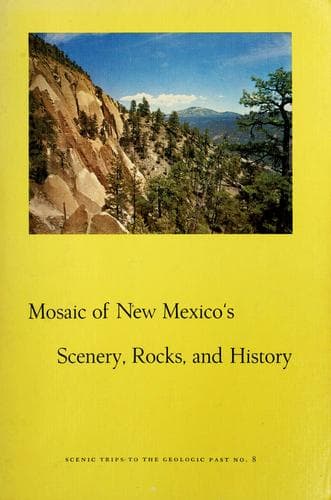
Mosaic of New Mexico's Scenery, Rocks, and History
History
Mosaic of New Mexico's Scenery, Rocks, and History
Geology -- New Mexico; New Mexico -- Description and travel; New Mexico -- History
Pojoaque, though still listed among the Indian villages of New Mexico,
is no longer populated by Indians. Two missions were established at
Pojoaque in the early Spanish days, the first shortly after 1600. This
was destroyed in the rebellion in 1680. Later, in 1706, a new church was
constructed which is still in use. The Indian population of Pojoaque was
gradually reduced until, in 1900, the few remaining families abandoned
the village. Since that time, Spanish-American families have occupied
the buildings. It is a picturesque village seldom seen, for it is hidden
from the passing tourist by a hill. Yet some of the buildings in this
ancient village date back to pre-Coronado times and are a significant
part of the romance of New Mexico.
Sandia Pueblo
Sandia Pueblo is a remnant of the Tiguex villages visited by Coronado in
1540. A mission was created at Sandia shortly after the colonization by
Oñate, and it was an important mission center until the Pueblo Revolt.
After the revolt, Sandia peoples scattered rather than again submit to
Spanish control. Many of them went to live with the Hopi and there
founded the village of Payupki on the middle mesa, the walls of which
can still be found. After 62 years, in 1742, a few families returned to
the Rio Grande Valley to found the modern pueblo. The old mission
remains visible, although reduced to a rubble of adobe. Sandia Pueblo
remains a small village, containing less than 150 people.
San Felipe Pueblo
San Felipe is one of the most conservative of the pueblos and has
retained much of its Indian heritage despite the impact of Spanish and
American influences. It has a close affinity with its neighbors,
particularly Santo Domingo only five miles distant. San Felipe was a
well-established village when the Spanish first arrived. Its people
joined in heartily when the pueblo uprising began in 1680 but abandoned
their village during a Spanish counteroffensive in 1681 (which failed).
When reconquest was completed in 1692, the people returned to their
village. Thereafter, they remained friendly to the Spanish and suffered
many attacks from the Navajo, who hated them for this loyalty.
One of the finest remaining structures showing early Franciscan mission
architecture can be seen at the San Felipe church. The present church is
not the original mission, for three different churches were located at
San Felipe over the centuries. The first was built in 1605 and destroyed
during the Pueblo Revolt. The second was built in a new part of the
village in 1694, but shortly after 1700, the village was moved and a new
church constructed. The latter church is the one now in use at San
Felipe. On May 1, the nearly 1000 people of the pueblo celebrate their
annual fiesta.
San Ildefonso Pueblo
Public-domain text, read in full here on John Shaqi.
Reviews
Reviews
No reviews yet
Be the first to share your thoughts on this work.
Elsewhere in the archive
Join the Discussion
Join the discussion
Sign in to leave a comment or review.
Sign InorCreate an account