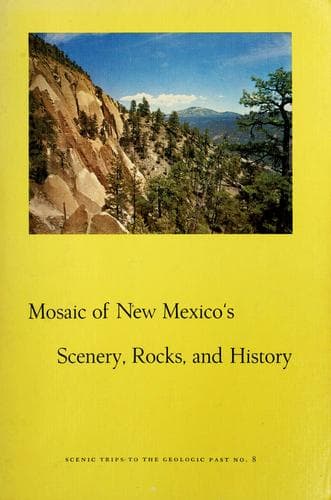
Mosaic of New Mexico's Scenery, Rocks, and History
History
Mosaic of New Mexico's Scenery, Rocks, and History
Geology -- New Mexico; New Mexico -- Description and travel; New Mexico -- History
Located at Laguna is the San Jose de Laguna mission, built in 1699. The
plaster on the building is native earth. Indian symbols are painted on
the ceiling of the chancel, and a large picture of St. Joseph done on
elk skin hangs on the reredos. The halos on the saints are triangular
rather than circular. The altar is covered with animal skins painted
with Christian symbols.
Nambé Pueblo
Nambé is one of the smallest of the pueblos but is located in an area
noted for its scenic beauty and climate. Its population is less than
200. It was not always so small; during the eighteenth and nineteenth
centuries, the population was greatly reduced by intertribal war and
witchcraft executions. The Nambé people played an active role in the
pueblo rebellion of 1680, murdering their priest and destroying their
church.
The original church at Nambé was one of the first missions founded after
the establishment of the first European settlement of San Gabriel at San
Juan in 1598. Destroyed in 1680, it was rebuilt in 1696. In 1729, the
converts had increased to such numbers that a new church was required.
This church remained in use until 1909 when, because of carelessness in
keeping it in repair, the roof collapsed during a storm. The annual
Nambé fiesta is held in early October.
Picurís Pueblo
Picurís is seldom visited by the tourist, for it lies in the mountains
forty miles north of Santa Fe and can only be reached over a gravel
road. The people of Picurís were among the most warlike of the normally
peaceful pueblo peoples. They participated actively in the pueblo
rebellion in 1680, killing their priest and all the Spaniards in the
vicinity. They also participated in the battle for Santa Fe which broke
Spanish power in New Mexico until 1692. After the revolt, fear of the
Spanish caused them to abandon their village until they were induced to
return in 1706. The population of Picurís is very small, being slightly
more than 100.
One of the few old missions left in New Mexico, the San Lorenzo de
Picurís church shows the strange mixture of Spanish and Indian
traditions. Near the door is a human skull covered with an old cloth,
but unfortunately, its story is lost to antiquity.
An interesting feature at Picurís is the unusual construction seen in
some of the buildings. Made of puddled adobe, they are the oldest still
standing of any pueblo in the Rio Grande Valley. The buildings were made
by pouring adobe mud into wall forms. This is the same kind of
construction that is found at Casa Grande, Arizona, one of the
significant prehistoric ruins in the United States.
Pojoaque Pueblo
Public-domain text, read in full here on John Shaqi.
Reviews
Reviews
No reviews yet
Be the first to share your thoughts on this work.
Elsewhere in the archive
Join the Discussion
Join the discussion
Sign in to leave a comment or review.
Sign InorCreate an account