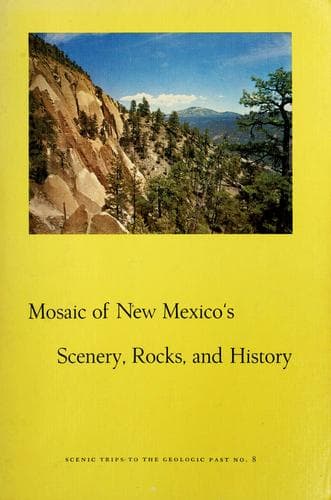
Mosaic of New Mexico's Scenery, Rocks, and History
History
Mosaic of New Mexico's Scenery, Rocks, and History
Geology -- New Mexico; New Mexico -- Description and travel; New Mexico -- History
Santa Ana Pueblo lies along the banks of the Rio Jemez, which enters the
Rio Grande from the west. The pueblo was visited by Oñate and a mission
was built there about 1600, shortly after his visit. The people of Santa
Ana joined in the Pueblo Revolt, and since there was no priest serving
their church in 1680, they joined with the Indians of Santo Domingo and
San Felipe to massacre the padres at San Felipe. In 1687, during one of
the Spanish efforts to reconquer New Mexico, Santa Ana was destroyed and
her people fled. Later, at the urging of de Vargas, the modern pueblo
was established, along with the church now standing there. The
population of Santa Ana is nearly 400. Its annual festival takes place
in August. It is often difficult to find many of the people at the main
pueblo for they spend most of the growing season at El Ranchito, to the
east in the Rio Grande Valley.
Santa Clara Pueblo
Santa Clara Pueblo is near the mouth of Santa Clara Creek, a year-round
stream flowing out of the Jemez Mountains into the Rio Grande. To the
west of the pueblo, on lands owned by Santa Clara, are the famous Puye
Cliff Dwellings ruins. The people of Santa Clara claim these natural
cliff homes as their ancestral dwelling places, a fact which has been
substantiated by archeologists. The Santa Clara Indians represent, then,
an important living Indian group in which one can observe institutions
and traditions that can be linked to traditions of the cultures that
lived in the caves and abandoned cities of Southwest antiquity.
Like most of the pueblo people, Santa Clara joined the Pueblo Revolt,
but this action did not seriously harm the pueblo. The real damage was
done to Santa Clara in the late eighteenth century when intertribal
warfare over witchcraft, plus the ravages of disease, took nearly 500
lives in the village. The current population is about 500.
The church at Santa Clara is quite modern, having been constructed in
the twentieth century. The old church, built in 1760, was caught up in
the modernization craze that swept through the pueblo world in the early
1900’s. Perhaps one of the most substantial and beautiful of all pueblo
churches, the old church collapsed during a storm in 1909 (the same
storm that destroyed the church at Nambé); it had been structurally
weakened by the removal of the roof for remodeling.
The village has excellent agricultural lands and supplements its income
by manufacturing an excellent and distinctive pure black pottery. Its
annual festival is in mid-August.
Santo Domingo Pueblo
Public-domain text, read in full here on John Shaqi.
Reviews
Reviews
No reviews yet
Be the first to share your thoughts on this work.
Elsewhere in the archive
Join the Discussion
Join the discussion
Sign in to leave a comment or review.
Sign InorCreate an account