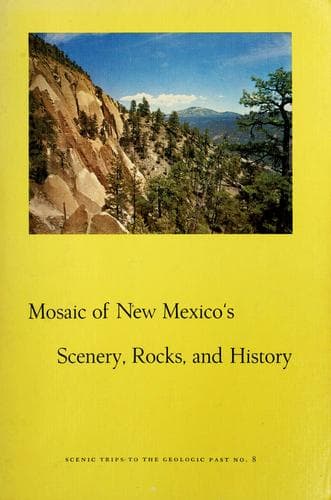
Mosaic of New Mexico's Scenery, Rocks, and History
History
Mosaic of New Mexico's Scenery, Rocks, and History
Geology -- New Mexico; New Mexico -- Description and travel; New Mexico -- History
Santo Domingo is one of the largest of the pueblos, having a population
of nearly 1500. It is also the most conservative in retention of its
native culture. This makes its dances and dress of particular interest
to the visitor to New Mexico. The present pueblo was established after
the reconquest in 1692. The Indians of Santo Domingo took a particularly
active part in the Pueblo Revolt, killing three padres resident at the
pueblo. When de Vargas moved to retake Santo Domingo, he found the
people had abandoned the village. They had constructed a village in the
Jemez Mountains to the west, and it was there that de Vargas defeated
them. Even then, the people of Santo Domingo did not give up the fight,
and only after a long series of defeats and serious loss of life did
they surrender and again return to the vicinity of their original
village.
The church at Santo Domingo is not so old as many other pueblo edifices,
but its qualities remain among the most typical aspects of early New
Mexico mission architecture. In early August, during the great annual
festival, the Indians completely clean and whitewash the church. Two
large horses are painted on the front of the building by native artists.
The dances during the Santo Domingo festival are among the most colorful
and authentic in New Mexico.
Taos Pueblo
Taos represents the northernmost of the pueblos in New Mexico. It is
also one of the most scenic, lying at the foot of the Taos Mountains, a
spur of the mighty Sangre de Cristo range. It is a prosperous village of
about 900 persons. There is no finer example of pueblo apartment
architecture in New Mexico. The main pueblo building rises five stories
above the mesa. One must be careful not to confuse the Spanish town, don
Fernando de Taos, and the old Indian farming center, Ranchos de Taos,
with the pueblo, San Geronimo de Taos. It is the latter that is Indian
and is, therefore, by far the oldest of the three.
Public-domain text, read in full here on John Shaqi.
Reviews
Reviews
No reviews yet
Be the first to share your thoughts on this work.
Elsewhere in the archive
Join the Discussion
Join the discussion
Sign in to leave a comment or review.
Sign InorCreate an account