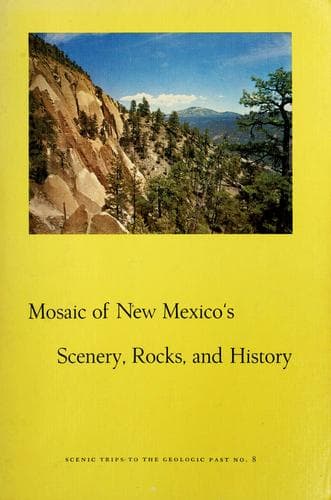
Mosaic of New Mexico's Scenery, Rocks, and History
History
Mosaic of New Mexico's Scenery, Rocks, and History
Geology -- New Mexico; New Mexico -- Description and travel; New Mexico -- History
Zia Pueblo
The story of Zia is one of tragedy and difficult problems of existence.
Located on a basalt flow on the north bank of the Jemez River some
fifteen miles above its junction with the Rio Grande, Zia has poor land
and a limited supply of irrigation water. Agriculture is the main
economic pursuit, but the pueblo’s unfortunate location makes trading
for part of its food supply necessary.
Oñate reported Zia to be a large pueblo. However, it suffered greatly
because of its participation in the Pueblo Revolt. Some historians
estimate that during the reconquest, nearly 600 of the people of Zia
were killed defending themselves from the Spanish. Continued wars and
pestilence reduced the pueblo to a very few families. Over the past
century, the group has again showed signs of growth and now has a
population of more than 300.
The church at Zia dates from 1692, and thus represents one of the fine
examples of ancient Franciscan architecture in New Mexico. The annual
festival, dedicated to Nuestra Senora de la Asuncion, is celebrated with
an excellent Corn Dance on August 15.
Zuni Pueblo
Zuni has the distinction of being the first of the pueblos seen or
visited by Europeans. Seen from a distance by Fray Marcos de Niza in
1539, it was reported as a rich and extensive city. Nearby were six
other pueblos, and the Spanish immediately associated the Zuni complex
with an old Spanish legend about seven golden cities, the Seven Cities
of Cibola. The expedition of Coronado was formed to explore and conquer
the rich pueblos of New Mexico. His first contact was at Zuni, then
called _Hawikuh_. It was neither golden nor rich.
Although Zuni was an important stopping place on the early trails to
Mexico, it managed to remain least influenced by European ideas. The
Spanish concentrated their efforts in the Rio Grande Valley and Zuni
went its own way most of the time. While there were missionary efforts
from time to time, by the nineteenth century, the stout resistance to
such activity caused it to cease. In recent years, sporadic missionary
activity has been evident, but it has not been notably successful.
The most famous of all New Mexico Indian ceremonial dances is held at
Zuni each year. The Shalako, which occurs in early December, is
authentic and spectacular. The dancers, carrying huge ceremonial figures
on their shoulders, must train and practice constantly during the entire
year.
Zuni is the largest of the pueblos in New Mexico, with a population
numbering more than 5000 persons. The main occupation is agriculture.
The Zunis supplement their income by manufacturing silver inlay jewelry
that shows great creative skill and is beautiful to behold.
Other New Mexico Indians
Public-domain text, read in full here on John Shaqi.
Reviews
Reviews
No reviews yet
Be the first to share your thoughts on this work.
Elsewhere in the archive
Join the Discussion
Join the discussion
Sign in to leave a comment or review.
Sign InorCreate an account