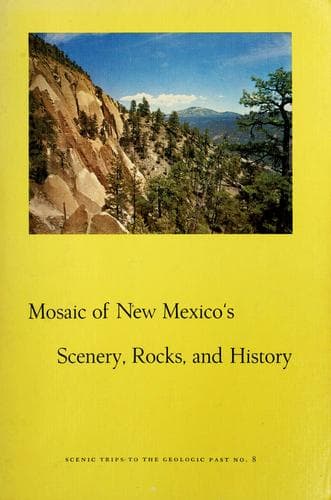
Mosaic of New Mexico's Scenery, Rocks, and History
History
Mosaic of New Mexico's Scenery, Rocks, and History
Geology -- New Mexico; New Mexico -- Description and travel; New Mexico -- History
While the history of these peoples is fascinating and full of romance,
there is little besides scenery to be seen when visiting their
reservations. The populations are often scattered over many hundreds of
square miles, and the people have only rudimentary handicrafts. The
exception is the Navajo, and a trip to the Navajo reservation is
worthwhile. These Indians have developed techniques of weaving and
silversmithing that contribute significant art forms to Southwest
handicrafts.
The outstanding Indian event of the year in New Mexico is the
Inter-Tribal Indian Ceremonial at Gallup, held during mid-August. Some
thirty tribes from the Southwest and Midwest meet to compete in arts,
crafts, and ceremonial dancing.
Reminders of the Past
_by_ Paige W. Christiansen
When driving across New Mexico or when visiting some part of the state,
one should be aware of the wealth of history that is always close at
hand. Many people, when faced with what seems like endless miles of
empty country, fail to realize that the very emptiness is one of the
charms of the state. They also do not recognize that in the vast
expanses of mountain and desert, people of the ancient past or a recent
past have lived and worked and died. Sometimes the fruits of their labor
are clear and evident and live on in cities and towns. In many
instances, however, the mountains and desert have reclaimed their own
and the works of man have succumbed. A mental picture must be cast over
the landscape on which great historical events took place but which is
almost empty of signs of man’s efforts. If travelers are fortunate,
there may still be some sign—a ghost town, a ruined ranch, some old
artifacts—to tell the story; if not, imagination must be given rein. The
search is the adventure, and to give aid in that search, the following
might suffice as a faint guiding light.
To simplify the descriptions of these reminders of the past, New Mexico
is divided into seven geographical regions which a traveler might well
visit:
1. _North from Santa Fe_, including U.S. Highways 64, 285, and 84, and
connecting state highways.
2. _The northeast_, including U.S. 85 from Santa Fe to Raton, U.S. 66
east from Albuquerque to the Texas line, U.S. 56 from Springer to the
state line, and connecting state highways.
3. _The northwest_, including U.S. 66 west from Albuquerque to the
Arizona line, U.S. 666 north from Gallup to Colorado, and State
Highway 44 from Bernalillo to Farmington.
4. _East-central_, including U.S. 60 east from Bernardo, U.S. 380 east
from San Antonio, U.S. 70 from the Mescalero Indian Reservation to the
Texas line, U.S. 285 from Clines Corners to Roswell, U.S. 54 from
Three Rivers to Santa Rosa, and connecting state highways.
5. _West-central_, including U.S. 60 west of Socorro, U.S. 180-260 and
State Highway 12 in Catron County, U.S. 85 from Los Lunas to Elephant
Butte, and connecting state highways.
Public-domain text, read in full here on John Shaqi.
Reviews
Reviews
No reviews yet
Be the first to share your thoughts on this work.
Elsewhere in the archive
Join the Discussion
Join the discussion
Sign in to leave a comment or review.
Sign InorCreate an account