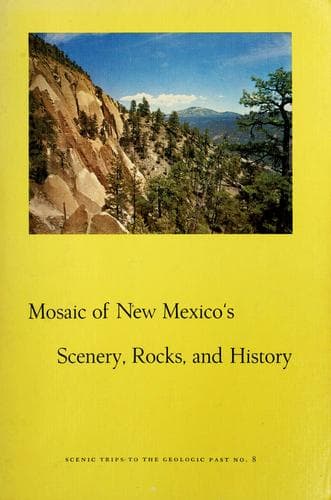
Mosaic of New Mexico's Scenery, Rocks, and History
History
Mosaic of New Mexico's Scenery, Rocks, and History
Geology -- New Mexico; New Mexico -- Description and travel; New Mexico -- History
6. _Southeast_, including U.S. 70 from Las Cruces to the Mescalero
Indian Reservation, U.S. 54 from El Paso to Three Rivers, U.S. 62 from
Hobbs to the Texas line, U.S. 285 from Roswell to the Texas line, and
numerous state roads.
7. _Southwest_, including U.S. 85 from Truth or Consequences to El
Paso, U.S. 180 north from Deming to the Catron county line, U.S. 70-80
west from Las Cruces to Arizona, and state roads.
North From Santa Fe
The country north of Santa Fe is the heart of Indian and Spanish New
Mexico. Here, if he looks beyond the narrow boundaries of the highway
right-of-way, the traveler can see Indian and Spanish villages which
have not changed significantly in two and a half centuries. Along the
lush green of the Rio Grande Valley or of its tributaries dashing out of
the Sangre de Cristo range to the east, these sleepy concentrations of
people reveal cultural and language patterns which smack of the
_conquistadores_ of the sixteenth century or of the ancient cliff
dwellers. It is a slow and easy world, perhaps most representative of
the “land of mañana.” In a region already worked for centuries for what
it can produce, there is no hurry. It will be there tomorrow and
forever. The people of this region are typically New Mexican. The hills
are dotted with piñon and juniper trees which give a greenish to black
cast to the land. This, too, is typically New Mexican.
[Illustration: (_Forest Service, U.S.D.A._)
Cool drive on a summer day, Red River Canyon]
There is one short trip that would be fruitful for him who wants to know
New Mexico, to feel the romance of Spanish culture, and to seek
adventure off the beaten track. Just north of Española, State Highway 76
strikes east from U.S. 64. Nowhere in the state can be found so much of
old world charm or spectacular scenic beauty. Heading east, the traveler
passes through Chimayó, a village famed throughout the world for its
weaving, though seldom visited, then on through Truchas and Las Trampas
to Penasco, heart of the Penitente country. The Penitentes were a
religious sect growing out of long isolation from the main threads of
Roman Catholicism. They gradually reverted to relatively primitive
Christian practices without guidance from main church centers but within
the past few years have returned to the Church. The many white crosses
that can be seen in the area attest to their former activity. From
Penasco, the traveler can return to U.S. 64 via State Highway 75.
The area northwest of Santa Fe, stretching some thirty or forty miles on
the southeast flanks of the Jemez Mountains, is the noted Pajarito
Plateau, the home of great numbers of Indian cultures, living and dead.
Many of the modern Indian pueblos will be found in this region. Also,
some of the most significant ancient Indian ruins are found here, such
as the Frijoles Canyon (Bandelier National Monument) and Puye Cliff
Dwellings.
Public-domain text, read in full here on John Shaqi.
Reviews
Reviews
No reviews yet
Be the first to share your thoughts on this work.
Elsewhere in the archive
Join the Discussion
Join the discussion
Sign in to leave a comment or review.
Sign InorCreate an account