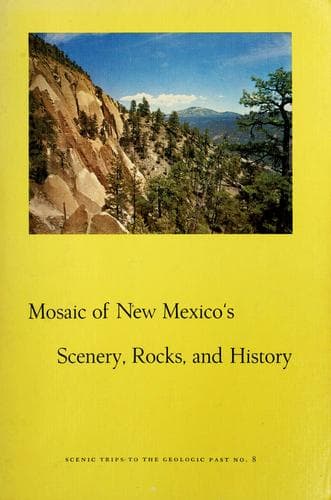
Mosaic of New Mexico's Scenery, Rocks, and History
History
Mosaic of New Mexico's Scenery, Rocks, and History
Geology -- New Mexico; New Mexico -- Description and travel; New Mexico -- History
Let the traveler be aware of several important facts when he passes
through this region. First, this is empty country, an area that has
fewer people now than it had eighty years ago. Its mines are mostly
closed and the towns that grew with the mines are ghosts. One of the
most famous of these is the town of Kelly, a short distance from the
community of Magdalena. Another is Mogollon, off U.S. Highway 180 in the
southwestern part of this region. Either of these will give to the
viewer a vivid picture of the mining camps of the nineteenth century.
To the average tourist crossing the San Agustin Plains, they seem
desolate and uninteresting. To the traveler with imagination and
knowledge of the history of this once great inland lake, the trip can be
exciting. He pictures this great basin full of water, forty-five miles
long and fifteen miles wide, and sees mountains covered with blue spruce
surrounding the great lake. His mental motion picture rolls on thousands
of years, watching the water evaporate and the forest of spruce die, to
be replaced eventually by the piñon and juniper now dotting the hills.
Grass grew in the old lake bed, except in the last areas to evaporate,
for these had an alkali content too high for most grasses. The traveler
then watches the Indian enter the scene—not the pueblo builder, except
as a transient, for no water is available. The nomadic warrior uses the
pathway later. In 1774 and in 1776, he sees several important battles
between the Spanish and the Apaches fought on these Plains. Later, the
American cattleman dominates them, as he does today....
And so the mosaic grows—Indians, Spanish, Americans, cattle, and
mines—and the spectacular vistas and the vast emptiness add color and
excitement for the traveler who sees the past with the present.
Southeast New Mexico
Much of southeast New Mexico is an extension of the Great Plains, but it
has some rugged mountains and a severe desert in the middle of which lie
White Sands National Monument and the White Sands Missile Range.
Mountain ranges include the Sacramento east of Alamogordo and the
Guadalupe Mountains, in which are located Carlsbad Caverns.
The plains part of this region are devoted to cattle, potash, and oil.
Like the other plains regions of New Mexico, the heritage passed on from
the great cattle empires of bygone days is very strong and detectable in
the people. Since the early 1930’s, oil has come to play an increasingly
important part in the history of this section. This is especially true
near Hobbs.
[Illustration: (_Forest Service, U.S.D.A._)
Anyone for a hike?... in the Guadalupe Mountains]
Public-domain text, read in full here on John Shaqi.
Reviews
Reviews
No reviews yet
Be the first to share your thoughts on this work.
Elsewhere in the archive
Join the Discussion
Join the discussion
Sign in to leave a comment or review.
Sign InorCreate an account