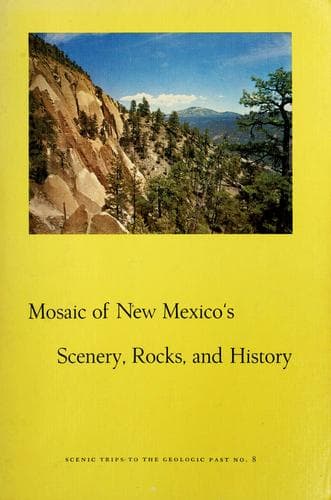
Mosaic of New Mexico's Scenery, Rocks, and History
History
Mosaic of New Mexico's Scenery, Rocks, and History
Geology -- New Mexico; New Mexico -- Description and travel; New Mexico -- History
Again, there is an intricate and varied mosaic. No simple land this, but
a complexity of plains, mountains, and desert, all of which color its
history. The Indians no longer inhabit their villages, the Spanish no
longer struggle along the Jornada del Muerto, and the free range of the
cattle baron is gone, but if the traveler sees it through its historical
past, it will again come alive.
West-Central New Mexico
This section is a complex and colorful mass of landforms scattered
helter-skelter across the western part of the state. It stretches from
the green Rio Grande Valley, with its irrigated lands, quaint farms, and
picturesque agricultural villages, up the Valley’s steep western slopes
to the rolling grassland and mesas and alluvial fans, ending in
precipitous and treacherous canyons in the rugged mountains. Socorro
Mountain, the Magdalenas, the San Mateos, the Ladrones, and countless
others seem always to ring the horizon. Some of them are timbered and
abound in cool, refreshing shade and springs; some are harsh and dry. In
the west, the famed San Agustin Plains stretch to the sunset, a wide
carpet fringed by black, timbered hills, site of fabulous cattle drives
of a bygone day. The complexity of the region’s geology, scenery, and
terrain is matched by an equally complex history.
The history is a mosaic of many hues, some harsh and stark like its dry
desert mountains, some inviting like the shade and coolness of its
timbered canyons and mountain springs. First were the many diverse and
sometimes hostile Indian cultures. There were peaceful pueblo peoples
tilling their lands, using the Rio Grande’s flowing water to produce
abundance. Also, prehistoric village dwellers struggled to create
agricultural societies along the banks of now-dry rivers in the western
part of the region. And there were the fearsome Apache Indians who
founded their homes in the broken mountain fastnesses and added their
excitement and tragedy to the mosaic. So, too, did the Spaniard make his
mark and the Mexican who followed close behind. The place names of the
eastern part of the region are primarily Spanish, although the Spanish
found the area a difficult one in which to maintain themselves. And then
the American came to dominate this land, adding realism and technology.
Finally, two major economic factors left a profound imprint: stock
raising and mining. The first began with the Spanish, was continued by
the Mexicans, and commercialized by the Americans. Everywhere are signs
of this heritage. Mining also played a dominant role, although of a
shorter duration. One can hardly lift his eyes to the hills without
seeing signs of the prospectors shovel or the miner’s work. One can
hardly converse with local citizens without discussing mines of the past
or mines of the future. Livestock and minerals, then, are woven through
the historical pattern and are never far from any part of the story.
Public-domain text, read in full here on John Shaqi.
Reviews
Reviews
No reviews yet
Be the first to share your thoughts on this work.
Elsewhere in the archive
Join the Discussion
Join the discussion
Sign in to leave a comment or review.
Sign InorCreate an account