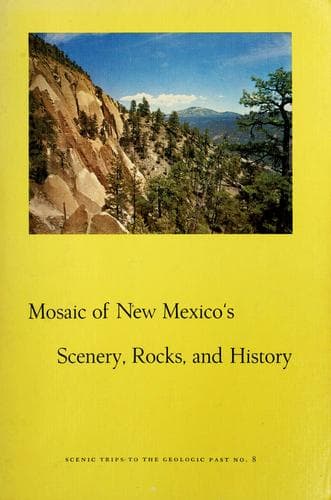
Mosaic of New Mexico's Scenery, Rocks, and History
History
Mosaic of New Mexico's Scenery, Rocks, and History
Geology -- New Mexico; New Mexico -- Description and travel; New Mexico -- History
The potash mines are among the most highly mechanized of the mineral
industry. Access to the buried deposits is gained by vertical shafts.
Actual mining is now done to a large extent by continuous miners,
machines which bore or rip the potash ore from the face and load it into
shuttle cars in one continuous operation. The shuttle cars then
transport the ore to conveyor belts which move it to the shafts for
hoisting. Working conditions and safety are excellent and have led to
high productivity from these mines.
The potash ore is refined or processed by fractional crystallation or
flotation. These plants remove most of the unwanted sodium chloride and
other gangue minerals to produce high-quality potassium chloride or
sulfate. After processing, the potash salts are stored in giant bins to
await shipment by rail to the major agriculture areas of the United
States. The Carlsbad mines produce some 15 million tons of ore a year
which, when refined, produces 4 million tons of marketable potassium
salts having a K₂O equivalent of 2.5 million tons.
[Illustration: (_Courtesy International Minerals & Chemical Corp._)
Crunch!... continuous mining machine at work]
Uranium mining is the newest major industry in New Mexico. The boom
started in 1950 with the discovery of uranium ore west of Grants by a
Navajo sheep rancher named Paddy Martinez. This discovery started one of
the most extensive exploration and development campaigns in all mining
history. By 1957, the area had proved uranium reserves accounting for
more than half of the entire reserve of the nation. These discoveries
will make this country self-sufficient in this vital atomic energy metal
for years to come. Five mills were built that are capable of producing
“yellow cake” (almost pure uranium oxide) from uranium ores containing
as little as 0.20 per cent U₃O₈. Four mills are located in the Grants
area, ranging in capacity from 1500 to 4000 tons a day. The fifth mill,
rated at 500 tons a day, is at Shiprock.
There are numerous mines, ranging from tiny two-man operations up to
great mines producing more than 1000 tons a day. The most prolific
producing area is the Ambrosia Lake District north of Grants; most of
these mines are underground. Probably the largest single uranium mine,
however, is the open-pit Jackpile-Paguate mine of the Anaconda Company
on the Laguna Indian Reservation some thirty miles east of Grants. The
mine uses electric shovels capable of loading eight cubic yards of ore
at a time into large diesel trucks.
Public-domain text, read in full here on John Shaqi.
Reviews
Reviews
No reviews yet
Be the first to share your thoughts on this work.
Elsewhere in the archive
Join the Discussion
Join the discussion
Sign in to leave a comment or review.
Sign InorCreate an account