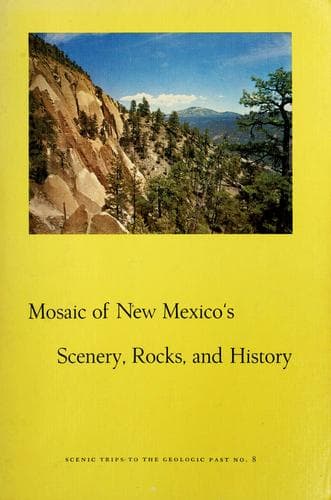
Mosaic of New Mexico's Scenery, Rocks, and History
History
Mosaic of New Mexico's Scenery, Rocks, and History
Geology -- New Mexico; New Mexico -- Description and travel; New Mexico -- History
Once the oil is on the surface, it passes through separators to remove
any admixed gas from the oil. The gas is sent into pipelines while the
oil is sent to storage tanks called _tank batteries_. Periodically, the
oil is drawn from the tank batteries where it is transported by pipeline
or rail to refineries. The great bulk of the crude oil leaves New Mexico
for refining via a major pipeline network extending through Texas to
both the Gulf and East coasts. Some oil is refined in New Mexico,
however. Oil refineries in Artesia, Bloomfield, Ciniza, Farmington, and
Monument have a combined capacity to treat some 30,000 barrels (42
gallons a barrel) of crude oil a day. On the other hand, practically all
the natural gas is treated in New Mexico so as to recover its liquid
petroleum constituents before sending it out of the state by pipeline.
MINING
The mining industry of New Mexico dates back to the days of Spanish
rule. Copper was mined from the Santa Rita mine as early as 1800 for
shipment to Mexico for use in coinage. Significant mining in New Mexico
did not commence, however, until the late 1800’s. There are three major
centers today: Carlsbad, potash; Silver City area, copper, zinc, and
lead; and Grants, uranium.
[Illustration: Question: where are the other oil pumps and tanks in
the San Juan Basin?]
The potash mining east of Carlsbad, a $75 million-a-year industry
employing more than 3600 persons, is the largest operation of its kind
in the world. Six mining companies are active in the area, and a seventh
is developing yet another mine. _Potash_ is a word used to denote
various potassium compounds. The principal ore mineral at Carlsbad is
sylvanite, a mixture of potassium chloride and sodium chloride (common
salt). The ore contains the equivalent of 21 to 25 per cent potassium
oxide (K₂O).[6] Another ore mineral, known as _langbeinite_, a double
salt of potassium and magnesium sulfate, is also mined.
The potash ores occur as horizontal beds sandwiched between thick salt
and anhydrite layers. These beds are the result of evaporation of large
quantities of salt waters during the latter part of the Permian period
some 240 million years ago. The potash-bearing horizons now are buried
from 900 to 1800 feet below the surface. The discovery of potash in
southeast New Mexico was almost by accident. In 1925, the Snowden and
McSweeny Company drilled a wildcat oil test a few miles east of
Carlsbad. The hole was dry, but potash minerals were detected in the
drill cuttings. The discovery generated considerable interest because
the United States was forced to import most of its potash prior to this
time. Further drilling proved the existence of tremendous deposits of
potassium salts in that area.
Public-domain text, read in full here on John Shaqi.
Reviews
Reviews
No reviews yet
Be the first to share your thoughts on this work.
Elsewhere in the archive
Join the Discussion
Join the discussion
Sign in to leave a comment or review.
Sign InorCreate an account