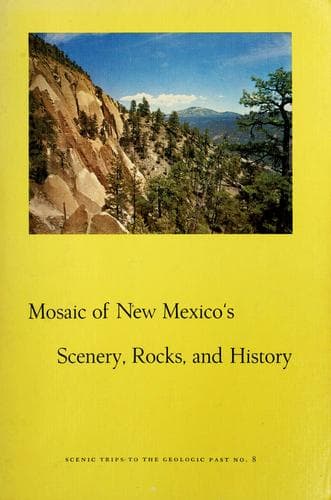
Mosaic of New Mexico's Scenery, Rocks, and History — John Shaqi
Mosaic of New Mexico's Scenery, Rocks, and History
History
Mosaic of New Mexico's Scenery, Rocks, and History
Geology -- New Mexico; New Mexico -- Description and travel; New Mexico -- History
Today, when we look at the cultural scene in New Mexico, we can see
direct evidence of Spanish occupation. The language of half the people
in the state is Spanish, in some areas still the Spanish of the
sixteenth century. Roman Catholicism, of which the Spanish were the most
Catholic, dominates the religious scene. The Spanish heritage in
political attitudes, in building and architecture, and in the legal
tradition of the state is apparent. New Mexico, of all the states in the
United States, is the only one that can claim a truly Spanish heritage.
ANGLO-AMERICAN VIGOR
While Spain lost its empire and New Mexico and the Southwest sank into
poverty and decay, yet another force was on the march, a force that
welled up in an Anglo-American people clinging to the Atlantic Coast of
North America. As these people developed a nation, they also discovered
a sense of destiny which turned their faces to the west and their
footsteps toward the sunset. With them moved their culture. At first, it
was a trickle, a few traders bent on profit, crossing the plains on the
Santa Fe Trail. Then the trickle became a flood. For New Mexico, these
men came as saviors. The Missouri traders broke the Chihuahua monopoly
and goods from all parts of the world began to flow into New Mexico,
resulting in higher standards of living. These Yankee traders, sensing a
good thing, also penetrated the markets of Mexico, using New Mexico’s
Royal Road to gain entrance.
Again there was conflict, not Spanish and Indian, but Latin and
Anglo-American. Mexico owned the lands of the Southwest and intended to
keep them. But this American, with his gaze glued on western skies,
refused to turn aside, and he strode on, grinding the feeble efforts of
Mexican resistance into the desert sands. The Mexican War in 1846,
suddenly transferred ownership of Texas, New Mexico, Utah, Nevada,
Arizona, and California from Mexico to the United States. This was
nearly half the territory of Mexico. New Mexico, with her already
complex cultural pattern, was subjected to still another influence.
The history of the American occupation of the Southwest is as complex
and diverse as its predecessors. Its ingredients include cattle, mining,
railroads, agriculture, science, and the Indian. All these, and others,
combined to give an Anglo-American slant to the Southwest. The Indian
culture did not disappear, nor did the Spanish, but rather a new stratum
was cast that was to complete the mosaic.
When the American arrived in New Mexico, he found a poor, backward area,
hungry for trade and outside contacts. He found the Indians of the
Southwest in open rebellion against the white men. The Navajo and other
Apache groups, the Comanche, and some of the Pueblos were the primary
offenders. This was to be the main problem occupying the time and energy
of the American settler and soldier for forty years after 1846. Until
the Indian situation was stabilized, there would be little economic and
social development.
Public-domain text, read in full here on John Shaqi.
Reviews
Reviews
No reviews yet
Be the first to share your thoughts on this work.
Join the Discussion
Join the discussion
Sign in to leave a comment or review.
Sign InorCreate an account