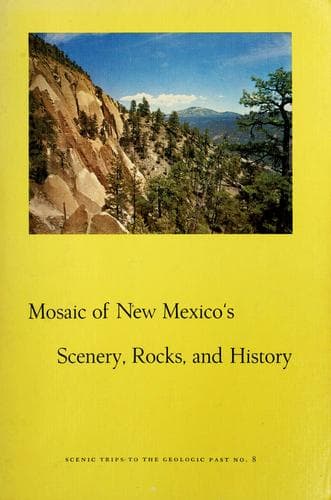
Mosaic of New Mexico's Scenery, Rocks, and History
History
Mosaic of New Mexico's Scenery, Rocks, and History
Geology -- New Mexico; New Mexico -- Description and travel; New Mexico -- History
This army entered New Mexico along the traditional route, moving up the
Rio Grande from El Paso. It quickly subdued the forts and Union troops
in southern New Mexico and continued up-river. On February 21, 1862, it
met a Union army commanded by Colonel E. R. S. Canby at Valverde, a
small community about twenty miles south of Socorro, New Mexico. Kit
Carson, New Mexico’s famous trapper and scout, commanded the New Mexico
Volunteers, a part of the Union force. Canby’s troops were beaten and
dispersed at the Battle of Val Verde, leaving the upper Rio Grande
Valley virtually without defense. Within a few weeks, the Texans had
taken Albuquerque and Santa Fe. But one stronghold in New Mexico
remained in the hands of the Union forces. Fort Union, northeast of Las
Vegas, New Mexico, became the focal point of action by both north and
south. Sibley, marching from Santa Fe, knew success depended on the fall
of Fort Union. The Union forces, equally aware of the importance of the
fort, hurriedly reinforced it with a number of volunteers from Colorado.
Within Fort Union, a crisis developed over differing opinions on
strategy. The fort commander wanted to keep the garrison at full
strength and fight the Confederates from within the fort. The Colorado
Volunteers wanted to go out and meet the enemy. The latter won and a
Union force moved into the passes of the Sangre de Cristo Mountains to
meet the Confederates in a fateful battle that would decide control of
the west. It was fought at Glorieta Pass on March 28, 1862. Despite the
fact that the two armies met on this field, the contest was not decided
there. Early on the morning of March 28, a force of 400 Colorado
Volunteers, commanded by Colonel John M. Chivington, began a flanking
action in hopes of hitting the Confederate rear. This group moved out of
the Pass into the mountains, and by a very difficult route moved back
toward the Pass behind the Confederate force. On a ridge overlooking
Apache Canyon, they saw below them the entire Confederate supply train
and cavalry horse herd. In a lightning hit-and-run attack, the supply
train and horses were destroyed. When word of this reached Sibley at
Glorieta Pass, there was little for him to do but to retire from the
field. The Confederate force never recovered from this disaster and
gradually retreated to Santa Fe, then back down the Rio Grande into
Texas.
Public-domain text, read in full here on John Shaqi.
Reviews
Reviews
No reviews yet
Be the first to share your thoughts on this work.
Join the Discussion
Join the discussion
Sign in to leave a comment or review.
Sign InorCreate an account