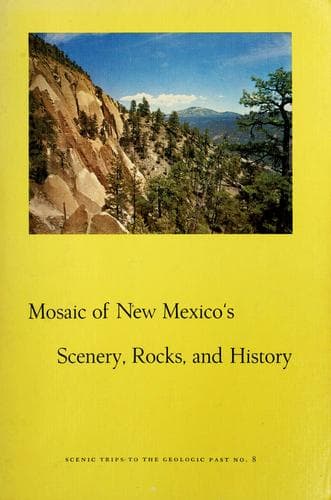
Mosaic of New Mexico's Scenery, Rocks, and History
History
Mosaic of New Mexico's Scenery, Rocks, and History
Geology -- New Mexico; New Mexico -- Description and travel; New Mexico -- History
Some popular education would seem to be desirable. And this applies,
too, to the cacti, for there is more misinformation about them than
anything else that grows, runs, or creeps—except rattlesnakes. The
clever people who design travel folders and pictorial maps almost always
put saguaros in New Mexico. But saguaros do not grow in New Mexico. That
is final! And the yucca is not a cactus. That also is final. Nor yet the
ocotillo—that defiant, splendid denizen of the desert which flaunts the
scarlet torch of flowers. The question that is always on the surface as
one writes of plant life in the Southwest is, “Who wants to know?” The
picnicker wants to know the names—and nothing much besides—of the wild
flowers. My friend the cowman already has the names; that is, the common
ones. If I chance to mention blue grama grass, he gently corrects me,
“black grama.” Then if I mention black grama, he says, “no, white
grama.” But at least he is concerned about something more important than
nonscientific names. He wants to know if the plant is something that a
lean old cow can eat, whether it stays green in winter, and if it will
hold the soil in place. The tourist who pilots car and passengers some
six hundred miles between breakfast and bedtime asks only what he was
looking at. The rest of us who go into the mountains often enough to be
impressed by the layer-cake succession of plants on their slopes can,
with the aid of some reading, amass a store of knowledge where others
amass only mileage. On a tour, it is mileage or knowledge. One has to
choose.
Actually, our New Mexico desert is not dominated by sage. That honor is
held by the creosote bush, called by some of the old-timers
_greasewood_, _Covillea glutinosa_, by some of the scientists—along with
five other synonyms. Like the mesquite with which it shares the same
general habitat but _does not intermix_, it occupies an immense spread
of territory, roughly from Texas to California. Since no livestock will
eat it and the ground it occupies is equally useless for agriculture
because of aridity and stoniness, creosote is a veritable coyote for
survival. The traveler descending from Taos to Santa Fe need not look
for it. The sage of that locality, which gives the landscape its
singularly mournful aspect, is a true sage. With good reason the cowboys
call it _black sage_.
Public-domain text, read in full here on John Shaqi.
Reviews
Reviews
No reviews yet
Be the first to share your thoughts on this work.
Join the Discussion
Join the discussion
Sign in to leave a comment or review.
Sign InorCreate an account