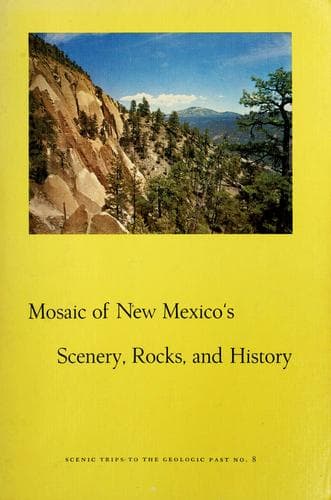
Mosaic of New Mexico's Scenery, Rocks, and History
History
Mosaic of New Mexico's Scenery, Rocks, and History
Geology -- New Mexico; New Mexico -- Description and travel; New Mexico -- History
During its forty-year history, Fort Union occupied three different
sites, all within the same general area. The original fort was of log
construction which rapidly fell into disrepair. In August 1861, amid
rumors of the possible invasion of the territory by Confederate forces,
construction was begun on a new fort. This fort was of earthworks, in
the form of an eight-pointed star. It was here that the troops waited
for the attack which never came. With the passing of the Confederate
threat, work was begun in 1863 on the third fort, the remains of which
are seen today.
Fort Union soon became the largest fort in the territory. It was
constructed in two sections, one for the garrison and one for the supply
depot. The garrison area consisted of four infantry and two cavalry
barracks facing a row of nine officers’ quarters across the parade
ground. A sixty-bed hospital was constructed. The depot area included
five warehouses, mechanics corral, transportation corral, and
administration buildings. An arsenal was built about one mile from the
fort proper.
The buildings were constructed of adobe on stone foundations. The roofs
were flat and the walls were capped with brick copings in what has
become the territorial style of architecture.
[Illustration: (_Photo courtesy of National Park Service_)
Ruins of Fort Union]
Fort Union was a community within itself and a lively social center.
Weary travelers on the Santa Fe Trail eagerly anticipated their arrival.
Few complaints were heard when soldiers were transferred to Fort Union,
for this was a popular assignment.
With the coming of the railroad and peace at last descending on the
frontier in the 1880’s, the need for the fort diminished. But it clung
to life for a few more years, mainly because of the fond memories which
lived in the hearts of the military leaders who had been stationed
there. Finally, the end came and Fort Union was abandoned in February
1891.
New life came to the fort in 1955 when it became a National Monument.
The ruins have been excavated and stabilized and a fine visitors’ center
and museum has been established. Fort Union has at last assumed its
rightful place as a shrine of history. Stand on the parade ground and
survey the majesty that was Fort Union, listen for the sounds, the bugle
calls, the barklike commands of close-order drill, the creak of wagons,
and the thunder of horses’ hooves. These are the sounds of Fort Union.
They are still there if one will only pause and listen.
Fort Marcy
Public-domain text, read in full here on John Shaqi.
Reviews
Reviews
No reviews yet
Be the first to share your thoughts on this work.
Elsewhere in the archive
Join the Discussion
Join the discussion
Sign in to leave a comment or review.
Sign InorCreate an account