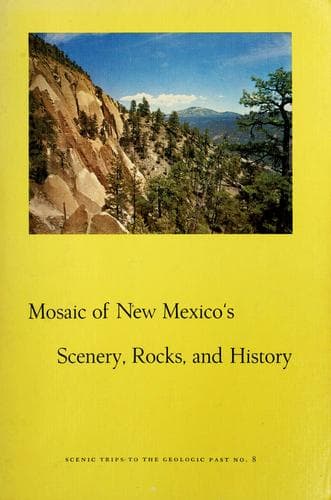
Mosaic of New Mexico's Scenery, Rocks, and History
History
Mosaic of New Mexico's Scenery, Rocks, and History
Geology -- New Mexico; New Mexico -- Description and travel; New Mexico -- History
Fort Marcy was established in 1846 at Santa Fe and was named for the
then Secretary of War, W. L. Marcy. The fort was located on a hill
overlooking the city some 1000 yards northeast of the plaza. A deep
ditch or moat surrounded the massive adobe walls of the fort and a
blockhouse, within musket range, protected the only entrance. At the
time of Colonel Manfield’s inspection trip in August 1853, the troops
were quartered in public buildings in Santa Fe, there being no quarters
provided at the fort; however, it could be occupied on a moment’s
notice. The original Fort Marcy was abandoned in 1867 and a new one was
constructed a short distance to the west. This new site is now occupied
by business and residential properties. The War Department abandoned
Fort Marcy in October 1894, the troops and equipment being moved to Fort
Sill, Oklahoma. The site was turned over to the city of Santa Fe in
1897.
Fort Marcy played an important role during the military occupation of
New Mexico. It served as a base of operations against marauding Indians,
was captured and occupied for a short time by Confederate forces in
1862, served as headquarters for the Ninth Military Department (changed
to Department of New Mexico in 1853) throughout most of this period, and
was a center for the social life of Santa Fe. Only low mounds of earth
now mark the site of Fort Marcy.
Fort Wingate
Fort Wingate, at the site known today, was established in 1868. It is
located on the site of a pre-existing fort at Ojo del Oso (Bear Springs)
about twelve miles east of Gallup and three miles south of U.S. Highway
66.
Fort Fauntleroy was established in August 1860 and was named for the
then Department Commander, Col. T. T. Fauntleroy. The name was changed
to Fort Lyon in September 1861 after Colonel Fauntleroy resigned his
commission and joined the Confederate forces. The fort was abandoned in
December 1861 as troops were concentrated at other posts to meet the
threat of invasion of the territory by Confederate forces from the
south. With the defeat of Confederate troops early in 1862, the military
returned to the Indian problem and established a post some sixty miles
to the east on the Rio de Gallo near San Rafael. This post was named
Fort Wingate in honor of Capt. Benjamin Wingate who died of wounds
received during the battle with the Confederate forces at Val Verde. The
post proved to be too far from the Navajo country for effective control
and, in 1868, was abandoned and a new Fort Wingate established at Ojo
del Oso on the site occupied earlier by Fort Fauntleroy.
The physical plant of the new Fort Wingate consisted of barracks,
officers’ quarters, hospital, guard house, storehouse, employees’
quarters, corrals, barns, and various repair and storage sheds, all
bordering the traditional rectangular parade ground. Some of these
buildings are in use today.
Public-domain text, read in full here on John Shaqi.
Reviews
Reviews
No reviews yet
Be the first to share your thoughts on this work.
Elsewhere in the archive
Join the Discussion
Join the discussion
Sign in to leave a comment or review.
Sign InorCreate an account