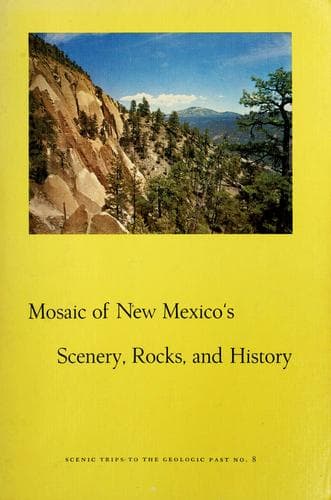
Mosaic of New Mexico's Scenery, Rocks, and History
History
Mosaic of New Mexico's Scenery, Rocks, and History
Geology -- New Mexico; New Mexico -- Description and travel; New Mexico -- History
In 1914, 4000 Mexican refugees lived in a tent city at Fort Wingate
until peace was restored after Pancho Villa’s revolution in Mexico.
Following World War I, it became an ordnance storage depot, and new
administrative and living quarters were built several miles west of the
original fort enclosure. This installation is known today as Fort
Wingate Ordnance Depot, and the long rows of concrete ammunition storage
bunkers can be seen from U.S. Highway 66. In 1925, the original fort
enclosure was transferred to the Department of the Interior for use as
an Indian school. Today, the parade ground is a playground and the
barracks are dormitories for the children who attend this school. The
missile age came to Fort Wingate in 1963 when a portion of the military
reservation became the launching site for test rockets which impact at
the White Sands Missile Range 200 miles to the south.
Fort Wingate has seen many changes during its long and colorful history.
It served well during its first 100 years and continues to serve today.
Fort Craig
Fort Craig was established in the spring of 1854 on the abandonment of
Fort Conrad, nine miles north. It was named in honor of Col. L. S. Craig
who was killed by an army deserter on June 6, 1852. The remains of Fort
Craig are located on the west bank of the Rio Grande about thirty-four
miles south of Socorro and five miles, by dirt road, east of U.S.
Highway 85. The fort was established to afford protection against the
many bands of Apaches that roamed this part of the territory.
Fort Craig was well built and became one of the best-garrisoned military
posts in New Mexico. Built on the usual rectangular plan, the parade
ground was bordered on the northeast by two double officers’ quarters;
on the northwest by the guard house, prison room, and sallyport; on the
southwest by three soldiers’ barracks each in the form of a hollow
square enclosing a patio; and on the southeast by various workshops,
storerooms, stables, and corrals. The commanding officers’ quarters
occupied the west corner of the parade ground and the hospital the east
corner. Behind the commanding officers’ quarters there were three large
bombproof storerooms. The entire installation was enclosed within a high
wall, beyond which a ditch encircled the fort. Gun bastions projected
from the north and south corners.
[Illustration: Remnants of guard house, Fort Craig (built of basalt
blocks)]
Public-domain text, read in full here on John Shaqi.
Reviews
Reviews
No reviews yet
Be the first to share your thoughts on this work.
Elsewhere in the archive
Join the Discussion
Join the discussion
Sign in to leave a comment or review.
Sign InorCreate an account