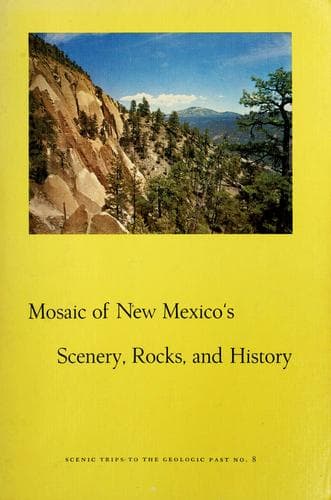
Mosaic of New Mexico's Scenery, Rocks, and History
History
Mosaic of New Mexico's Scenery, Rocks, and History
Geology -- New Mexico; New Mexico -- Description and travel; New Mexico -- History
The original fort consisted of log and adobe buildings forming a square
around the parade ground. During its thirty-four year history as an army
post, many changes and additions were made to the fort, including the
building of two-storied officers’ quarters. In 1899, the line troops
were removed and the fort was officially designated as a U.S. Army
General Hospital to treat tubercular soldiers. In 1920, the hospital was
turned over to the Public Health Department; in 1922, to the U.S.
Veterans Administration; and again, in 1966, to the State Health
Department as a facility for the care of the aged and of tuberculosis
cases. It can now accommodate more than 300 patients. The modern
buildings are a far cry from the dirt-floored log and adobe buildings of
the original fort.
HISTORY
_Pre-Civil War Period._
The period 1846 to 1861 was characterized by constant Indian warfare.
Treaties were made, then broken. Forts were established, then abandoned,
and new forts built as the military tried in vain to cope with the
problem. Punitive expeditions proved ineffective as the Indians
separated into small and predatory bands which overran the country.
Forts Union, Marcy, Fauntleroy, Craig, and Stanton were established
during this period. Additional forts, whose sites have returned to the
desert, are Fort Conrad (1851), on the Rio Grande about twenty-five
miles south of Socorro; Fort Thorn (1853), on the Rio Grande about five
miles north of Hatch; Fort Fillmore (1851), on the Rio Grande about
seven miles south of Las Cruces; Fort Webster (1852), on the Mimbres
River about one and one-half miles northwest of San Lorenzo; Fort McLane
(1860), at Apache Tejo about four miles south of Hurley; and Fort Floyd
(1857), on the Gila River about two miles south of Cliff.
_Civil War Period._
The outbreak of the Civil War in 1861 created a new problem on the
frontier in New Mexico. Confederate military leaders moved quickly to
seize control of the Southwest and California to cut off the supply of
gold to the North and divert it to the Confederacy. Confederate troops
under Col. J. B. Baylor occupied abandoned Fort Bliss at Franklin (El
Paso), Texas on July 1, 1861. Baylor began his move northward along the
Rio Grande on July 23 and quickly occupied Mesilla. Nearby Fort Fillmore
was abandoned and the Union forces retreated toward Fort Stanton, but
they were soon captured by Baylor’s troops. Upon the fall of Fort
Fillmore, Fort Stanton was hastily abandoned on August 2 and was taken
over by the Confederates shortly thereafter.
Public-domain text, read in full here on John Shaqi.
Reviews
Reviews
No reviews yet
Be the first to share your thoughts on this work.
Elsewhere in the archive
Join the Discussion
Join the discussion
Sign in to leave a comment or review.
Sign InorCreate an account