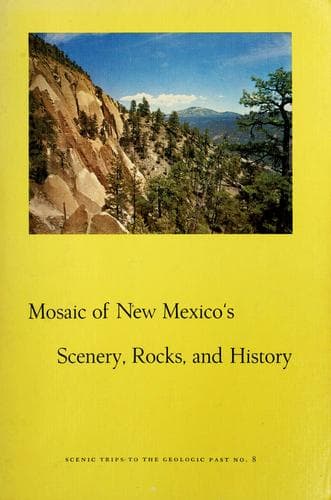
Mosaic of New Mexico's Scenery, Rocks, and History
History
Mosaic of New Mexico's Scenery, Rocks, and History
Geology -- New Mexico; New Mexico -- Description and travel; New Mexico -- History
Gen. H. H. Sibley arrived at Fort Bliss in December 1861 to assume
command of the Confederate forces. Sibley’s troops moved northward along
the Rio Grande and were engaged in battle by Union troops from Fort
Craig, under Gen. E. R. S. Canby, as they attempted to bypass the
well-garrisoned post. The Battle of Val Verde took place four miles
north of Fort Craig on February 21, 1862. After a day of bloody
fighting, Sibley emerged the victor. He occupied Albuquerque on March 2,
1862, and Santa Fe on March 23. The Confederate forces then moved toward
Fort Union in an attempt to gain complete control of the territory. On
March 27 and 28, they were met by Union forces sent out from Fort Union
and were defeated in battle near present-day Glorieta. Sibley then
retreated to Fort Bliss.
[Illustration: The Confederate campaign in New Mexico, 1861-1862]
While Sibley was thus engaged, another part of his army moved across
what is now southwestern New Mexico and southeastern Arizona and
occupied Tucson (Arizona). Gen. J. H. Carleton and his California Column
left Los Angeles on April 13 and cleared this area of Confederate
troops, reaching the Rio Grande on August 7. Carleton reoccupied Fort
Bliss, which had been abandoned by the Confederate troops in their
retreat.
_Post-Civil War Period._
While the Union troops were preoccupied with the Confederates, the
Indians stepped up their raids and depredations. With the passing of the
Confederate threat, attention was once more focused on the Indian
problem. A new plan was formulated which called for the capturing of the
Indians and confining them to reservations. A reservation (Bosque
Redondo) was established late in 1862 near present-day Fort Sumner, New
Mexico, to which were eventually confined several thousand Navajos and
Mescalero Apaches. This resettlement was not a success since the Apaches
ran off and the Navajos suffered greatly from sickness and disease. A
treaty was signed with the Navajos in 1868, and they were allowed to
return to their homes, no longer a threat to the frontier. The Mescalero
Apaches were finally settled on a reservation in their own country south
of Fort Stanton, and the Jicarillas on a reservation west of Tierra
Amarilla.
Public-domain text, read in full here on John Shaqi.
Reviews
Reviews
No reviews yet
Be the first to share your thoughts on this work.
Elsewhere in the archive
Join the Discussion
Join the discussion
Sign in to leave a comment or review.
Sign InorCreate an account