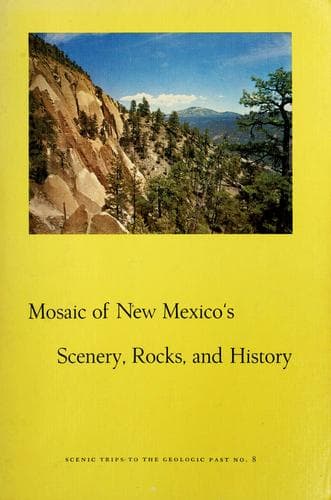
Mosaic of New Mexico's Scenery, Rocks, and History
History
Mosaic of New Mexico's Scenery, Rocks, and History
Geology -- New Mexico; New Mexico -- Description and travel; New Mexico -- History
Incomparable Carlsbad Caverns is in the state’s only National Park.
National Monuments include the glistening gypsum dunes of White Sands,
the volcanic cone of Capulin Mountain, the prehistoric ruins of Chaco
Canyon, Aztec Ruins, Bandelier, and Gila Cliff Dwellings, the Spanish
ruins at Gran Quivira, Inscription Rock at El Morro, and the crumbling
walls of old Fort Union. In the near future, Valle Grande may be added
to the National Park System and will include Valle Caldera, one of the
world’s largest volcanic calderas, a mountainous jumble with cool
streams, thick coniferous forests, and lush high meadows.
NEW MEXICO’S BIG SHARE OF THE NATIONAL PARK SYSTEM
_by_ H. V. Reeves, Jr.[2]
In contemplating the growth of cities and towns, the insatiable suburbs,
congested streets and highways, the acres of dump yards for discarded
automobiles, legions of billboards upstaging mountain ranges and
seashores, and the melancholy predictions of demographers who say that
within thirty years there will be twice as many of us, consider this:
for New Mexico in particular, the outlook is not utterly bleak.
Some ninety years ago, without anything approaching the present-day
horrible example before them, some farsighted, selfless, tireless
individuals began to work to set aside areas of outstanding scenic,
scientific, and historical interest so that they would not be engulfed
by humanity. Often against strong opposition, these benefactors
succeeded in bringing about legislation that bounded many such areas and
defined laws to protect them. The areas became national parks,
monuments, and historic sites. And in 1916, the National Park Service,
an agency of the U.S. Department of the Interior, was established to
administer the units of the National Park System.
Today, other selfless individuals are contributing their time and effort
to bring additional areas into the National Park System before they are
lost forever. For example, Pecos ruins became a National Monument in
late 1966 (see page 106).
Not every suggested area possesses the qualities that merit
preservation, qualities of national significance. Proposed areas receive
careful study before they are recommended for inclusion within the
system—recommended to the Congress by the Secretary of the Interior. The
Secretary’s recommendations are based on those received from the
Advisory Board on National Parks, Historic Sites, Buildings, and
Monuments. This board is composed of eleven private citizens, each of
whom is competent in one or more of the following fields: history,
natural history, archeology, architecture, conservation, and recreation.
Diverse in character, New Mexico’s ten units of the National Park System
are of geologic, scenic, archeological, and historical interest. A visit
to each unit will disclose the qualities that have been judged to be of
national significance.
Carlsbad Caverns National Park
Public-domain text, read in full here on John Shaqi.
Reviews
Reviews
No reviews yet
Be the first to share your thoughts on this work.
Elsewhere in the archive
Join the Discussion
Join the discussion
Sign in to leave a comment or review.
Sign InorCreate an account