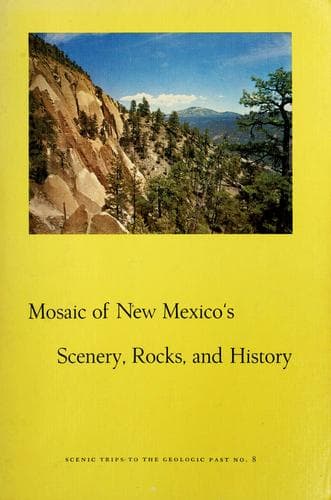
Mosaic of New Mexico's Scenery, Rocks, and History
History
Mosaic of New Mexico's Scenery, Rocks, and History
Geology -- New Mexico; New Mexico -- Description and travel; New Mexico -- History
Incomparable Carlsbad Caverns, in southeastern New Mexico, includes a
single underground chamber so expansive that its floor could accommodate
fourteen football fields and its ceiling could hold a 22-story building;
other chambers that contain countless cave formations of great variety
of shape and color; cool and naturally circulating fresh air; and a
system of lighting that reveals the beauty and spaciousness most
effectively.
Since the temperature within the Caverns remains at about 56°F the year
round, warm clothing is needed. Comfortable shoes, too, for the
four-hour, three-mile complete tour, which starts at the natural
entrance. Shorter trips, the Big Room tours that start at the elevators
in the visitor center, take in only a part of the underground chambers.
All tours are under leadership of competent park guides who answer
questions and explain the earth processes that have resulted in the
caverns and their amazing decorations.
From the natural entrance, the immense main corridor of the Caverns is
followed downward 829 feet for one and three-quarters miles. This brings
visitors to the most scenic rooms (the Green Lake Room, King’s Palace,
Queen’s Chamber, and Papoose Room), where the stalactites, stalagmites,
and helictites reach their peak in numbers, shapes, and delicate
coloring. The trail leads upward 80 feet from the Papoose Room to the
lunchroom. Near the lunchroom is the Big Room, the most majestic of the
Caverns’ chambers. The trail around its perimeter, one and a quarter
miles long, encompasses a floor space of fourteen acres.
[Illustration: Hall of Giants in Carlsbad Caverns National Park]
Completing the circuit of the Big Room and returning to the lunchroom,
visitors may either walk or board an elevator and ride smoothly back to
the surface.
How were the Caverns formed? The story began about 240 million years
ago, during the Permian Period. At that time, the two limestone
formations in which the caverns occur—the Tansill Formation and Capitan
Limestone—were deposited as part of an organic reef complex at the edge
of a warm shallow sea.
During subsequent periods, other seas brought in sedimentary material
that covered the reef. About 60 million years ago, earth movements,
which were responsible for the uplift of the area, fractured the reef
and permitted surrounding ground water to enter along fracture lines and
begin work in fashioning the caverns. The water at first dissolved small
crevices in the limestone. As more water came in, the crevices enlarged
to cavities, called solution pockets. Then the walls, floors, and
ceilings of the pockets dissolved and collapsed, joining the pockets,
while the solution process continued, eventually forming the huge rooms
seen today.
Public-domain text, read in full here on John Shaqi.
Reviews
Reviews
No reviews yet
Be the first to share your thoughts on this work.
Elsewhere in the archive
Join the Discussion
Join the discussion
Sign in to leave a comment or review.
Sign InorCreate an account