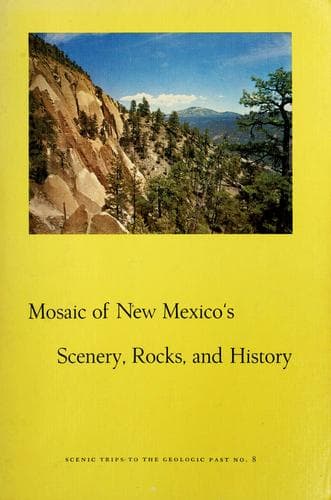
Mosaic of New Mexico's Scenery, Rocks, and History
History
Mosaic of New Mexico's Scenery, Rocks, and History
Geology -- New Mexico; New Mexico -- Description and travel; New Mexico -- History
Beginning about 3 million years ago and into recent times, the uplift of
the local Guadalupe Mountains and changing climates lowered the water
table. Water that had been inside the caverns drained away and was
replaced by air. Most solution stopped, but large sections of partly
dissolved walls and ceilings collapsed under their own weight. Stability
was finally achieved, however, and probably no rock has fallen within
the caverns during the last several thousand years.
Even before the collapsing ended, another phase of cavern development
had begun. Rain water and snow melt slowly seeped into the caverns.
Droplets of water, each holding a minute quantity of dissolved
limestone, appeared upon the ceilings. Exposed to the air, the droplets
evaporated and left their mineral content as calcite and
aragonite—crystalline forms of limestone. Over centuries, this process
of evaporation and deposition has built a myriad of crystalline
stalactites of all shapes and sizes. Water that dripped to the floor
evaporated and deposited the calcite and aragonite to build stalagmites.
When joined together, stalactites and stalagmites become columns, or
pillars. In the scenic rooms, conditions existed that brought about the
creation of helictites—twisted formations that seem to defy gravity in
their growth. Color in the cave formations, shades of brown, red, and
yellow, result from the presence of small amounts of iron oxide and
other minerals.
Carlsbad Caverns National Park offers more than the caverns themselves.
Each evening from April to October, bats in incredible numbers spiral
upward out of the Caverns’ entrance and fly southward over the rim of
the escarpment to feed in the valleys of the Black and Pecos rivers.
They return just before dawn, diving swiftly and from high altitudes
into the entrance. Flying directly to the bat cave, they spend each day
hanging head downward in dense clusters from the walls and ceilings. The
bat cave itself is not open to visitors. A park naturalist explains the
bat flight and discusses the bats in detail in a talk given at the
entrance to the Caverns each evening before the flight begins.
The nature trail, a half mile loop that begins and ends near the
entrance to the Caverns, guides the visitor to many of the desert plants
of the region. The park is visited by more than half a million people
each year, and yet the delicate cave formations and the natural beauties
remain unmarred.
White Sands National Monument
White Sands National Monument, fifteen miles southwest of Alamogordo, is
another area of great interest to the geologist and biologist. But its
strangeness, the graceful contours of its snow-white dunes, and the
peculiar adaptations of some of the plants and animals that live among
its dunes are appreciated as fully by the nonscientist. More than
370,000 visitors come to marvel at the White Sands each year.
Public-domain text, read in full here on John Shaqi.
Reviews
Reviews
No reviews yet
Be the first to share your thoughts on this work.
Elsewhere in the archive
Join the Discussion
Join the discussion
Sign in to leave a comment or review.
Sign InorCreate an account