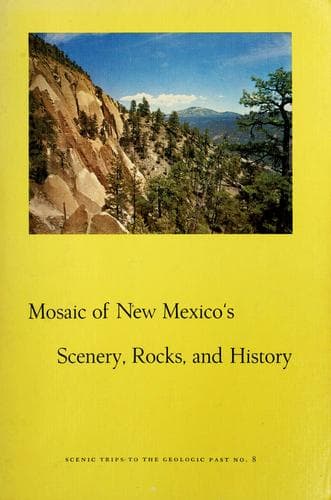
Mosaic of New Mexico's Scenery, Rocks, and History
History
Mosaic of New Mexico's Scenery, Rocks, and History
Geology -- New Mexico; New Mexico -- Description and travel; New Mexico -- History
In this great volcanic area, the lava erupted in a succession of flows.
The series of eruptions were separated by long periods of inactivity.
During these inactive times, erosion cut valleys and wore down parts of
the old lava sheets. This action formed new channels and lower terrain
over which succeeding lava flows spread. This process was repeated at
least three times. The oldest lavas, which have been exposed by erosion,
are found on the tops of the highest mesas. The last series of eruptions
created Capulin Mountain; they were ejections mostly of cinders and ash,
with less lava flow than in the preceding volcanic activity. These
cinder-and-ash eruptions were so recent, geologically, that some of the
nearby, bare, steep-sided cinder cones appear as if they had just
cooled.
The National Park Service has constructed a road up the mountain to the
rim of the crater. And from the parking area at the rim, two trails lead
to the most interesting points on the mountain. One trail, self-guiding,
makes the complete one-mile circuit of the crater along the rim. A guide
booklet, keyed to numbered stakes that have been set at places along the
trail, explains the features of particular significance—both on the
mountain and in the distance. The other trail, less scenic, provides a
rare opportunity to see a volcanic mountain from the inside out, for it
leads down to the bottom of the crater.
[Illustration: View of Chaco Canyon National Monument]
Chaco Canyon National Monument
Rich in areas of geological interest, New Mexico is equally rich in
areas of archeological interest. Four of these are preserved as units of
the National Park System.
Chaco Canyon National Monument, in the northwestern part of the state,
contains more than a dozen large prehistoric ruins and hundreds of
smaller archeological sites. These ruins are considered to be without
equal north of central Mexico. No other archeological area in the
Southwest exhibits such a high development of prehistoric Pueblo
civilization. Most of the sites lie within a strip of land about eight
miles long and two miles wide, through which Chaco Canyon runs. Although
the Monument is relatively isolated, it is open year around and is
visited by about 22,000 people annually.
The most imposing and best known of the ruins is Pueblo Bonito. Built
between 800 and 900 years ago, this 4- and 5-story village covered more
than three acres and contained about 800 rooms and 32 kivas, or
ceremonial chambers. Archeologist Neil M. Judd, of the National Museum,
who conducted some of the late excavations, has said that Pueblo Bonito
was the largest apartment house built anywhere in the world prior to
1887, estimating that at one time it housed 1200 people.
Public-domain text, read in full here on John Shaqi.
Reviews
Reviews
No reviews yet
Be the first to share your thoughts on this work.
Elsewhere in the archive
Join the Discussion
Join the discussion
Sign in to leave a comment or review.
Sign InorCreate an account