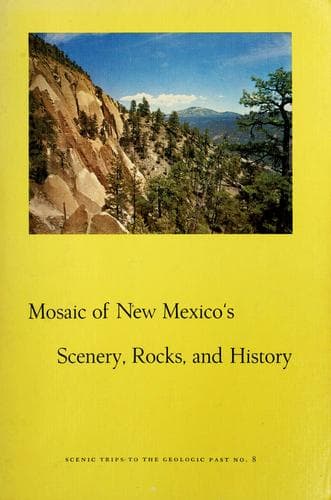
Mosaic of New Mexico's Scenery, Rocks, and History
History
Mosaic of New Mexico's Scenery, Rocks, and History
Geology -- New Mexico; New Mexico -- Description and travel; New Mexico -- History
Earliest of the Chaco sites, small villages of crude pit houses were
occupied during 600 to 800 A.D. Archeologists, studying changes in
masonry style, pottery types, and other remains, have pieced together
the development of the culture of the inhabitants of Chaco Canyon over a
period of six centuries.
After Chaco Canyon’s cultural high point was reached in the 1100’s, a
gradual decline set in. The population decreased, and in the 1200’s, the
region was abandoned. During this same century, other Pueblo centers
within the San Juan Basin were also deserted.
Various theories have been advanced to explain this exodus: soil
erosion, warlike enemies, poor facilities for urban sanitation, drought,
and intervillage warfare. One or a combination of these factors might
have been instrumental in bringing about the abandonment of the region.
Aztec Ruins National Monument
Aztec Ruins National Monument, at Aztec in the northwestern corner of
the state, was set aside to preserve an outstanding example of classical
Pueblo construction, one of the largest pre-Spanish villages in the
Southwest. More than 40,000 visitors come to the Monument each year.
Tree-ring dates indicate that most of the big central pueblo was rapidly
constructed during the period 1106 to 1121. At this time, the people of
Aztec were influenced by the cultural center to the south, Chaco Canyon.
During the last half of the 1100’s, after the decline of Chaco Canyon
had begun, the people of Aztec began to look toward the north, and by
1200, Mesa Verde ideas dominated the region. Aztec was abandoned by
about 1300, as was the rest of the general region.
Of particular interest at Aztec Ruins National Monument is the
reconstructed Great Kiva. The Pueblo Indians built separate rooms, now
known as kivas, for ceremonial purposes. During the period of Chaco
influence, the people at Aztec constructed a very large circular
building, 48 feet in diameter, in their plaza. Its features differ from
those of the small kivas and establish it as a Great Kiva, similar to
those at Chaco. The Great Kivas represent the peak of religious
architecture among the Pueblos. The Great Kiva at Aztec was completely
restored in 1934 by Earl H. Morris, of the American Museum of Natural
History.
Bandelier National Monument
Bandelier National Monument, forty-six miles west of Santa Fe, preserves
the ruins of dwellings and other structures that were erected by Indians
who lived in the area until about 1550 A.D. Almost 100,000 people visit
the Monument each year.
When many of the ancient Pueblo Indian centers were abandoned in the
late thirteenth century, the people moved to locations where the water
supply was more constant. A favorable area was the upper Rio Grande
Valley in what is now New Mexico. One of the later flowerings of Pueblo
culture occurred here. The ruins within Bandelier are representative of
this phase of Pueblo development.
Public-domain text, read in full here on John Shaqi.
Reviews
Reviews
No reviews yet
Be the first to share your thoughts on this work.
Elsewhere in the archive
Join the Discussion
Join the discussion
Sign in to leave a comment or review.
Sign InorCreate an account