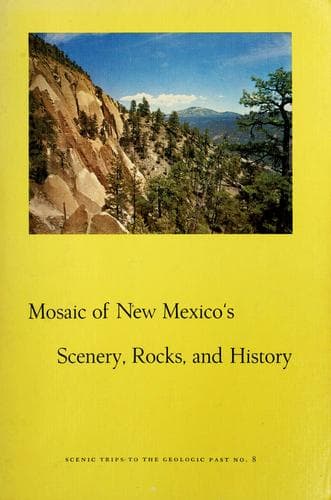
Mosaic of New Mexico's Scenery, Rocks, and History
History
Mosaic of New Mexico's Scenery, Rocks, and History
Geology -- New Mexico; New Mexico -- Description and travel; New Mexico -- History
The Indians of the Rio Grande Valley and the Apache who controlled most
of the Southwest managed an uneasy coexistence. The Pueblo Indians
remained basically farmers, holding fast to the cultural advances made
by their ancestors during the millennium preceding 1300. The Apache, for
the most part, remained nomadic predators, living off nature’s bounty,
or better still, raiding the pueblos for food. The Apache groups began
to take on names and traditional areas which they called their own. In
northern New Mexico were the Jicarilla Apache and in the southeast, the
Lipan, the Mescalero, and the Natage Apache. In northeastern Arizona
were the Navajo and in the drainage of the Gila River, the Chiricahua,
the Gila, and other groups of the Western Apache. Each of these groups
made its mark upon the face of the land.
SPANISH CONTRIBUTIONS
This was the situation in the Southwest when the sixteenth century
opened, but a new force was abroad which would grow and strengthen and
leave a deep imprint on New Mexico. Beginning on the wild islands of the
Caribbean and then fanning out into the heart of Mexico and the South
American continent, this new force spread across the face of America.
Europeans, more exactly, Spaniards, came bent upon conquest for its own
reward, for the glory of God, and for gold. These sturdy men from the
Iberian peninsula with weapons vastly superior to the Indians’, with the
horse which made them highly mobile and devastating in battle, and with
tactics and precision in warfare unknown among the Indians, were to
sweep without serious setback across the great cultures of Mexico and
Central and South America. By 1540, they were ready to take their next
leap forward.
On the west coast of Mexico, at a place called Culiacan, a colorful host
gathered. In their ears rang the words of the legend of the Seven Cities
of Cibola, seven golden cities, a legend which had been popular in Spain
for many generations. Mexico City had produced wealth, and the Spanish
were ready to believe that other fabulous cities existed. One Spaniard
had already crossed part of North America and had heard from the Indians
tales of the rich cities. His name was Cabeza de Vaca, and the
exuberance of his tales fired the imagination of the Spaniards.
Public-domain text, read in full here on John Shaqi.
Reviews
Reviews
No reviews yet
Be the first to share your thoughts on this work.
Join the Discussion
Join the discussion
Sign in to leave a comment or review.
Sign InorCreate an account