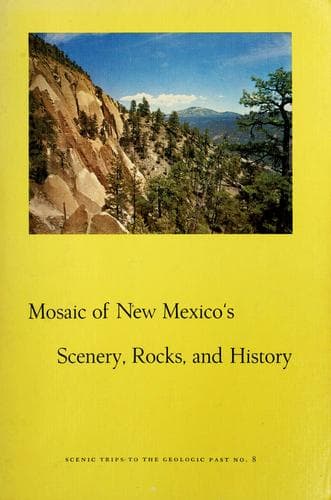
Mosaic of New Mexico's Scenery, Rocks, and History
History
Mosaic of New Mexico's Scenery, Rocks, and History
Geology -- New Mexico; New Mexico -- Description and travel; New Mexico -- History
[Illustration: Part of the pool and cliff at El Morro]
The oldest dated inscription at El Morro was made in 1605 by don Juan de
Oñate, first governor of New Mexico. Returning from an expedition to the
mouth of the Colorado River, he camped at El Morro and carved this
inscription in Spanish: “Passed by here the Adelantado Don Juan de Oñate
from the discovery of the Sea of the South, the 16th of April of 1605.”
The “Sea of the South” was the Gulf of California.
If don Diego de Vargas, the most famous Spanish governor of New Mexico,
seems boastful in the message he left at El Morro, who can blame him?
His words, in English, read, “Here was the General Don Diego de Vargas,
who conquered for our Holy Faith and for the Royal Crown all of New
Mexico at his own expense, year of 1692.” Twelve years earlier, the
great Pueblo Indian Revolt had driven the Spaniards from New Mexico.
More than 400, including 23 priests, had lost their lives, and the
surviving Spaniards, some 1100, had fled to El Paso del Norte. De Vargas
restored order, without further bloodshed, in 1692.
After the occupation of Santa Fe by the army of Gen. Stephen W. Kearny
in August 1846, details of United States troops were dispatched to
explore various parts of New Mexico. Probably the first to visit El
Morro was Lt. J. H. Simpson, accompanied by the artist R. H. Kern, who
copied some of the early inscriptions in September 1849. Then the names
of other soldiers, traders, Indian agents, surveyors, emigrants who were
traveling westward, and settlers were added to the rock.
Since the establishment of the Monument by Presidential proclamation in
1906, inscribing on the face of the cliff has been prohibited. If the
Monument had not been established and the law not passed, this
fascinating part of the history of the Southwest would surely have been
lost.
Fort Union National Monument
Fort Union National Monument, twenty-six miles northeast of Las Vegas
and on the route of the old Santa Fe Trail where the mountains meet the
plains, preserves the ruins of a famous frontier Army post. As a base of
operations for military and civilian ventures in New Mexico from 1851 to
1891, Fort Union helped to direct the course of events in the formative
years of the Southwest. More than 11,000 visitors come to the Monument
each year.
Five years after the conquest of New Mexico by the United States in the
war with Mexico, Col. E. V. Sumner moved some of his troops from Fort
Marcy, in Santa Fe, to the site of Fort Union and there began
construction of log buildings on the west side of Coyote Creek. This was
the first Fort Union.
The first post took an active part in protecting settlers and traders
from Indian raids during the 1850’s. Mounted patrols of dragoons made
many expeditions into the mountains against the warring Apaches and Utes
and out onto the plains to pursue Comanche war parties.
Public-domain text, read in full here on John Shaqi.
Reviews
Reviews
No reviews yet
Be the first to share your thoughts on this work.
Elsewhere in the archive
Join the Discussion
Join the discussion
Sign in to leave a comment or review.
Sign InorCreate an account