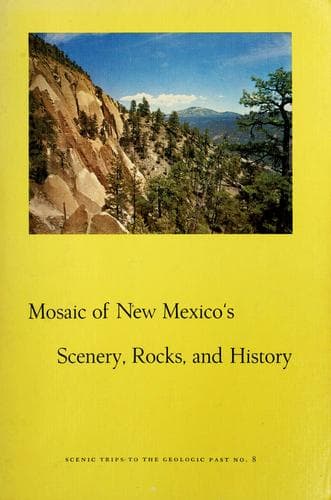
Mosaic of New Mexico's Scenery, Rocks, and History
History
Mosaic of New Mexico's Scenery, Rocks, and History
Geology -- New Mexico; New Mexico -- Description and travel; New Mexico -- History
Fort Union was also charged with supply and support of many outlying
military posts, such as Fort Defiance and Fort Craig. The Quartermaster
Depot at Fort Union in later years came to be the hub of all Army supply
services in the Southwest.
During the first three decades of its life, Fort Union saw the great
Conestoga wagons and prairie schooners of the Santa Fe Trail caravans
pass in increasing numbers. By the outbreak of the Civil War,
enterprising traders were hauling more than ten million dollars’ worth
of goods from Missouri each year. The fort provided escorts for caravans
and when requested by apprehensive company or postal officials, escorts
for stage-coaches of the Independence-Santa Fe Mail. Century-old tracks
of the Santa Fe Trail can be still seen near Fort Union.
The start of the Civil War in 1861 brought new activity to the fort.
Immediate invasion of New Mexico by Confederate forces from Texas was
expected. Gen. E. R. S. Canby, commanding Union troops in the territory,
began construction of an earthwork fortification in a defensive position
about a mile from the original fort. The ditches, parapets, and
bomb-proofs of this redoubt were completed late in 1861.
The Texas column was not slow in coming. By March 1862, these invaders
under Gen. Henry H. Sibley had defeated a Union force at Val Verde, had
frightened the defenders from Albuquerque and Santa Fe into inaction,
and were marching eastward across the mountains toward the final
stronghold, Fort Union. On March 10, the First Regiment of Colorado
Volunteers, under Col. J. P. Slough, arrived at Fort Union as
reinforcements. And on March 22, Colonel Slough led his 1342 men out of
the fort to meet the advancing Confederates. In a two-day battle fought
in Apache Canyon and Glorieta Pass, the Union forces defeated the
Confederates, thus saving Fort Union for the federal cause.
From 1863 to 1869, the garrisons at Fort Union were chiefly occupied in
a construction program that produced most of the adobe-walled buildings
whose ruins may now be seen. Fort Union then returned to its earlier
mission of a base for Indian fighting.
The usefulness of Fort Union was reduced with the final submission of
the Indians and with the arrival of the railhead at Las Vegas in 1879.
The huge fort was demoted to caretaker status in the 1880’s and was
abandoned in 1891.
At each of these New Mexico units of the National Park System, as at
other units throughout the nation, trained personnel of the National
Park Service—archeologists, historians, naturalists, and park
rangers—are on duty. Their purpose is to make the visitor’s trip
rewarding. This they do through museum exhibits, guided walks and
self-guiding trails, campfire talks, and publications.
Public-domain text, read in full here on John Shaqi.
Reviews
Reviews
No reviews yet
Be the first to share your thoughts on this work.
Elsewhere in the archive
Join the Discussion
Join the discussion
Sign in to leave a comment or review.
Sign InorCreate an account