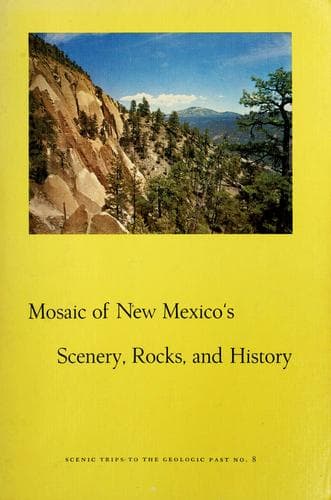
Mosaic of New Mexico's Scenery, Rocks, and History
History
Mosaic of New Mexico's Scenery, Rocks, and History
Geology -- New Mexico; New Mexico -- Description and travel; New Mexico -- History
The ruins of the ancient mission church of San Gregorio de Abo and its
pueblo, built of red sandstone, are in a broad, natural amphitheater
rimmed on the north and west by the blue Manzano Mountains, which
contrast strikingly with the reddish hues of the Abo sandstone. This is
one of the Saline Missions, so called because of the nearby salt
deposits in the Estancia Basin.
It was built during the seventeenth century by Indians under the
supervision of the Franciscans, led by the venerable Fray Francisco de
Acevedo. The inhabitants of Abo were very friendly to the Spaniards.
They were forced to abandon their pueblo about 1673 because of drought
and the raids of the Apaches and Comanches. They then moved south to El
Paso del Norte where they joined in founding Isleta del Sur.
The walls of the pueblo have disintegrated with time into low mounds
which lie adjacent to the mission. The ecclesiastical structures have
been excavated and repaired for permanent preservation.
Quarai State Monument
This monument is near Punta de Agua, eight miles north of Mountainair
off State Highway 10.
The ruins of the mission church of the Immaculate Conception at Quarai
are unsurpassed in grandeur of architecture or setting by any that
survive from the labors of the early Franciscans in New Mexico. Built of
red sandstone masonry about 1628, at the Pueblo of Quarai, it was
abandoned along with the pueblo about 1674, chiefly because of Apache
depredations.
One of the most venerated of the Franciscan missionaries, Fray Geronimo
de la Llana, worked and died at Quarai, beloved by his Indian charges.
His remains now rest in a crypt in the wall of St. Francis Cathedral in
Santa Fe. The ruins have been excavated and repaired for permanent
preservation.
Coronado State Monument
This pueblo ruin is on the west bank of the Rio Grande, one mile from
the town of Bernalillo, seventeen miles north of Albuquerque, and one
mile off U.S. Highway 85, between Albuquerque and Santa Fe.
The Pueblo of Kuaua was one of the several towns of the ancient Tiguex
province. At or near Kuaua, the Coronado expedition maintained
headquarters from about 1540 to 1542 A.D. During excavation of the
ancient pueblo, more than 1200 ground-floor rooms were found and five
kivas, or underground ceremonial chambers, were uncovered.
In one of the kivas was found a highly important group of ancient wall
paintings. This kiva has been reconstructed and the paintings restored.
The old walls of Kuaua have been rebuilt to a few feet in height so that
the structure can be seen. A museum has been erected on the site to
exhibit the material found during the excavation and to portray life in
the Tiguex province. The Coronado State Monument and Museum commemorates
the meeting, more than four hundred years ago, of the elements that
influenced the culture of New Mexico—the Indian and the _conquistadore_.
Public-domain text, read in full here on John Shaqi.
Reviews
Reviews
No reviews yet
Be the first to share your thoughts on this work.
Elsewhere in the archive
Join the Discussion
Join the discussion
Sign in to leave a comment or review.
Sign InorCreate an account