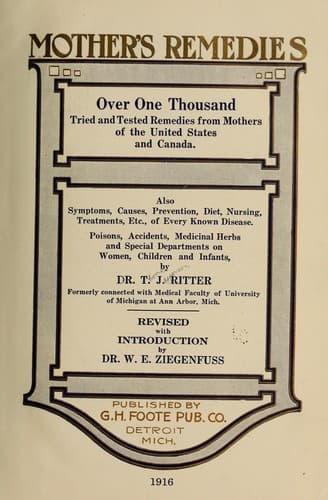
Mother's Remedies: Over One Thousand Tried and Tested Remedies from Mothers of the United States and CanadaRitter, Thomas Jefferson
Science
Mother's Remedies: Over One Thousand Tried and Tested Remedies from Mothers of the United States and Canada
Ritter, Thomas Jefferson
Etiquette; Formulas, recipes, etc.; Medicine, Popular
3. The following is a splendid local application.--Cleanse thoroughly the
inflamed part with pure castile soap and water, and then wash this off
with one to one thousand corrosive sublimate solution. Dry the skin with a
soft towel and apply a thick coating of equal parts of Ichthyol and
vaselin, and over this place antiseptic gauze or sterilized absorbent
cotton. Keep this in place with adhesive straps. If the diseased surface
is small it may not be necessary to use the gauze, etc.
4. Tincture Chloride of Iron in dose of ten to twenty drops and more if
necessary four times a day, well diluted with water. This is very hard on
the teeth and should be taken through a glass tube.
Diet.--Milk, broths, etc., liquid diet or foods. (See Nursing Dept. under
liquid diet.)
Nursing.--When you nurse any infectious patient, you must be not only
careful of your patient, but of yourself. It is not necessary in order to
do good nursing to endanger yourself; and a nurse who does not know how to
care for herself, cannot successfully nurse the sick. In erysipelas I
always watch the eruption closely. Sometimes it recedes, and the patient,
of course, is worse. Then there are some people who believe in "pow-
wowing." They have that done and then do not take care of themselves. I
have attended such cases. One case was especially striking. The "pow-wow"
person did his work and then the patient thought himself well and
proceeded to enjoy himself and caught cold. The result was the "going in"
of the eruption and a beautiful cough. I succeeded in my efforts and the
next day he had the erysipelas going along nicely, but no cough. I write
this so you will take proper care of yourself and shun conjurers and their
"pow-wow."
TOXEMIA, SEPTICEMIA; PYEJMIA.--Toxemia refers to the group of symptoms and
lesions caused by the presence in the blood of toxins (poison) usually
resulting from bacterial growths.
Septicemia refers to the condition caused by the presence in the blood of
bacteria (microbes) as well as toxin.
Pyemia refers to the same condition as septicemia with the development of
fresh places of suppuration.
Sapremia is a septic intoxication, the result of the absorption of toxins.
[INFECTIOUS DISEASES 223]
SEPTICEMIA.--The presence of bacteria in the blood, introduced from a
local lesion (wound, injury, etc.) or with no obvious local infection.
Symptom.--If there is a local infection, symptoms of this precede the
septicemia. The invasion may be sudden or gradual, with chill or chilly
feelings, followed by symptoms of active fever and later of an asthenic
(absence of strength and feeling) fever, with dry tongue and dullness or
delirium. Death may occur in one to seven days.
PYEMIA.--This means the presence in the blood of bacteria with resultant
foci (places) of suppuration.
Public-domain text, read in full here on John Shaqi.
Reviews
Reviews
No reviews yet
Be the first to share your thoughts on this work.
Elsewhere in the archive
Join the Discussion
Join the discussion
Sign in to leave a comment or review.
Sign InorCreate an account