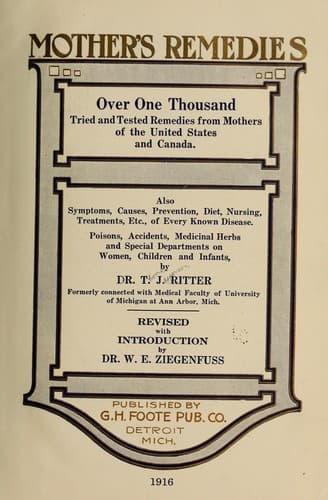
Mother's Remedies: Over One Thousand Tried and Tested Remedies from Mothers of the United States and CanadaRitter, Thomas Jefferson
Science
Mother's Remedies: Over One Thousand Tried and Tested Remedies from Mothers of the United States and Canada
Ritter, Thomas Jefferson
Etiquette; Formulas, recipes, etc.; Medicine, Popular
Symptoms.--They are local at first where the lesion is. The invasion of
the general infection is marked by a severe chill, then high fever and
sweating, repeated daily or at irregular intervals.
Fever is variable with sudden falls. In some cases the fever assumes very
weakening type and the patient looks like a case of typhoid fever in the
third week, and death soon occurs.
In other cases the chills, fever and sweating are repeated at irregular
intervals. The patients are emaciated and the skin has a sallow color.
Death usually occurs eventually from exhaustion in a few days or months.
Local Treatment.--This should be attended to from the beginning. If you
injure your finger or any part and it soon looks red, and feels sore, open
it up thoroughly with a clean instrument and cover it with a clean gauze
or cotton. It must not be covered too tightly so that the discharge, if
any, can leave the wound. Enough dressing must be put on to absorb that.
Then keep the wound clean, and so it can "run" if necessary. If you
neglect this or do it carelessly and admit dirt you will make it worse.
See treatment of wounds, etc.
General Treatment.--Keep the strength up in every way. The strength should
be kept up by giving nourishing diet that will suit that special case and
medicine that will produce a tonic effect, such as quinine and strychnine.
ASIATIC CHOLERA.--This is an acute infectious disease caused by a specific
organism and characterized by profuse watery discharges from the bowels
and great prostration.
Causes.--Some inherit a weakness, making them more susceptible than others
to this disease. Other causes are intemperance, general debility,
unhygienic surroundings, exciting causes. The spirillum (cholera
asiaticus) found in the stools, watery discharges and intestines of
affected cases and its transmission by infected food and water.
[224 MOTHERS' REMEDIES]
Symptoms.--After an incubation period of about one to five days, the
invasion is marked either by simple diarrhea with some general ill-feeling
and prostration, or by abdominal pains, vomiting and diarrhea. Mild cases
may recover at this time. In the stage of collapse, there are frequent
watery movements resembling rice water, with vomiting, great thirst,
abdominal pains and eruptions on the legs. There is sudden collapse and
temperature that is below normal; nearly all secretions are greatly
diminished. In the so-called cases of cholera sicca (dry) death occurs
before the diarrhea begins, although a rice water fluid is found in the
intestines after death. After two to twenty-four hours those who have not
died may recover or pass into the stage of reaction in which the signs of
collapse and purging disappear. After improvement, with slight rise of
temperature at times, there may be a relapse or the patient may have
inflammation of some of the viscera (cavity organs) and suppression of the
urine with delirium, coma and death.
Public-domain text, read in full here on John Shaqi.
Reviews
Reviews
No reviews yet
Be the first to share your thoughts on this work.
Elsewhere in the archive
Join the Discussion
Join the discussion
Sign in to leave a comment or review.
Sign InorCreate an account