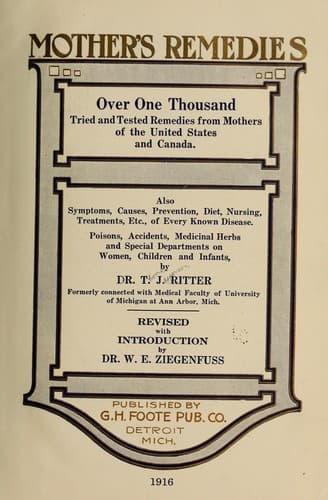
Mother's Remedies: Over One Thousand Tried and Tested Remedies from Mothers of the United States and CanadaRitter, Thomas Jefferson
Science
Mother's Remedies: Over One Thousand Tried and Tested Remedies from Mothers of the United States and Canada
Ritter, Thomas Jefferson
Etiquette; Formulas, recipes, etc.; Medicine, Popular
twenty or twenty-five years after their entrance into the system. These
calcified capsules appear as white specks in the muscles. In many
instances however these worms are completely calcified. In the hog the
trichinae cause few if any symptoms. An animal, the muscles of which are
swarming with living trichinae, may be well nourished and healthy looking.
An important point also is the fact that in the hog the capsule does not
readily become calcified, so that the parasites are not visible as in the
human muscles.
Modes of Infection.--The danger of infection depends entirely upon the
mode of preparation of the flesh. Thorough cooking, so that all parts of
the meat reach the boiling point, destroys the parasites; but, in larger
joints, the central portions are not often raised to this temperature. The
frequency of the disease in different countries depends largely upon the
habits of the people in the preparation of pork. In North Germany, where
raw ham and wurst are freely eaten, the greatest number of instances have
occurred. In South Germany, France, and England cases are rare. Salting
and smoking the flesh are not always sufficient, and the Havre experiments
showed that animals are readily infected when fed with portions of the
pickled or the smoked meat as prepared in this country.
[52 MOTHERS' REMEDIES]
Symptoms.--The eating of trichinous flesh is not always followed by this
disease.
In the course of a few days after eating the infected meat there are signs
of disturbance of the stomach and bowels, and pain in the abdomen, loss of
appetite, vomiting and sometimes diarrhea; and yet, these preliminary
symptoms do not always occur, for in some of the large epidemics cases
have been observed in which they have been absent. Pain in different parts
of the body, general debility and weakness have been noted in some of the
epidemics. In some instances the stomach and bowel disturbances have been
so marked from the outset that the attack resembled our cholera. The
invasion symptoms develop between the seventh and tenth day. Sometimes not
until the end of the second week, and they are marked by fever, a chill in
some cases and pain and swelling and tenderness along the muscles
involved. The migration of the parasites into the muscles excites a more
or less intense inflammation of these muscles, which is characterized by
pain on pressure and movement, and by swelling and tension of the muscles,
over which the skin may be swollen. The limbs are placed in some position
in which these muscles are more at rest. Difficulty in chewing and
swallowing is caused by the involvement of the muscles controlling these
acts. In severe cases the involvement of the diaphragm and intercostal
muscles may lead to difficult breathing (Dyspnoea) which sometimes proves
fatal. Watery swelling, a feature of great importance, may be seen early
in the face, particularly about the, eyes. Later it develops in the
Public-domain text, read in full here on John Shaqi.
Reviews
Reviews
No reviews yet
Be the first to share your thoughts on this work.
Elsewhere in the archive
Join the Discussion
Join the discussion
Sign in to leave a comment or review.
Sign InorCreate an account