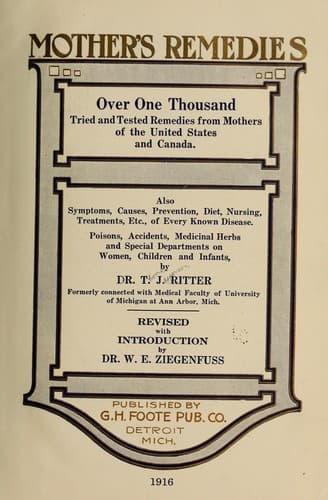
Mother's Remedies: Over One Thousand Tried and Tested Remedies from Mothers of the United States and CanadaRitter, Thomas Jefferson
Science
Mother's Remedies: Over One Thousand Tried and Tested Remedies from Mothers of the United States and Canada
Ritter, Thomas Jefferson
Etiquette; Formulas, recipes, etc.; Medicine, Popular
extremities when the swelling and stiffness of the muscles are at their
height. Profuse sweats, tingling and itching of the skin and in some
instances hives (Urticaria) have been described.
There are emaciation and anemia. In the severe cases the appearance may be
like that in the third week of typhoid fever. In mild cases the fever and
muscular symptoms subside in ten to fourteen days, in others only after
two or three months. The mortality, from one to thirty per cent, seems to
depend upon the virulence and number of parasites.
PHYSICIANS' TREATMENT.--If discovered within twenty-four to thirty-six
hours, thoroughly empty the bowel with purgatives. Rhubarb and senna, or
an occasional dose of calomel may be given. Relieve the pains afterwards
and support the strength.
[SKIN DISEASES 53]
DISEASES OF THE SKIN.
The skin is divided into three layers. Beginning with the outer one and
naming inward, they are named as follows: The outer layer is called the
epidermis or cuticle (near or upon the skin). The second layer is called
the corium, derma cutis vera, or true skin. The third layer is called the
sub-cutaneous (under the skin) (fatty or connective) tissue. This last
layer contains the sweat glands, the lower end of the deep-seated hair
follicles, (little sacs containing the roots of the hair) and larger
branches of the lymphatics, blood vessels and nerves, and serves in
general as a bed for the true skin to rest upon, and by which the true
skin is connected with the deeper parts, muscles, etc. The appendages of
the skin are the hair, nails, sebaceous and sweat-glands. The discharge
from the sweat-glands form a little or larger tumor. The contents of a wen
are from sebaceous glands--fat secretions--fat tumor. The following names
are frequently mentioned in the skin diseases:
Macule. (Spots, patches). Skin is altered in color, but the skin is not
raised or depressed; freckle, etc.
Papule. (Pimple). Elevated piece of skin, varying in size from a pin-head
to a coffee bean.
Tubercle. (Node-lump). A solid elevation of the skin, varying in size from
a pea to a cherry.
Tumors. These are soft or firm elevations of the skin, like a wen or hard
lump. They are always deep-seated.
Wheel. A round flat, white or pink elevation of the skin; such as hives,
mosquito bites, etc.
Vesicle. This is a pin-head or pea-sized elevation of the outer layer
(epidermis) filled with a watery fluid.
Bleb. (Bulla). A circumscribed elevation of the skin and contains a watery
fluid, such as a burn, etc.
Pustule. A rounded elevation of the outer layer (epidermis) of varying
size, containing pus (matter).
A vesicle, bleb, and pustule are hollow; macule, papule, and tubercle are
solid.
Scale. (Squama). This is a dry attached or unattached thin piece from the
skin as a result of disease of the skin.
Crust. This is a dried mass as a result of fluid oozing from a diseased
skin.
Excoriation. Like a scratch mark.
Public-domain text, read in full here on John Shaqi.
Reviews
Reviews
No reviews yet
Be the first to share your thoughts on this work.
Elsewhere in the archive
Join the Discussion
Join the discussion
Sign in to leave a comment or review.
Sign InorCreate an account