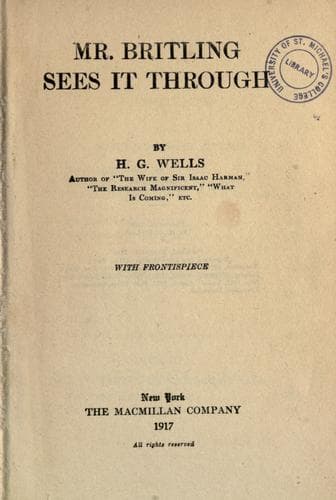
Mr. Britling Sees It ThroughWells, H. G. (Herbert George)
General
Mr. Britling Sees It Through
Wells, H. G. (Herbert George)
War stories; World War, 1914-1918 -- Fiction
Even if the bank did reopen Mr. Britling was aware that his current
balance was low; at the utmost it amounted to twenty or thirty pounds.
He had been expecting cheques from his English and American publishers,
and the usual _Times_ cheque. Suppose these payments were intercepted!
All these people might, so far as he could understand, stop payment
under this moratorium! That hadn't at first occurred to him. But, of
course, quite probably they might refuse to pay his account when it fell
due.
And suppose _The Times_ felt his peculiar vein of thoughtfulness
unnecessary in these stirring days!
And then if the bank really did lock up his deposit account, and his
securities became unsaleable!
Mr. Britling felt like an oyster that is invited to leave its shell....
He sat back from his desk contemplating these things. His imagination
made a weak attempt to picture a world in which credit has vanished and
money is of doubtful value. He supposed a large number of people would
just go on buying and selling at or near the old prices by force of
habit.
His mind and conscience made a valiant attempt to pick up "And Now War
Ends" and go on with it, but before five minutes were out he was back at
the thoughts of food panic and bankruptcy....
Section 5
The conflict of interests at Mr. Britling's desk became unendurable. He
felt he must settle the personal question first. He wandered out upon
the lawn and smoked cigarettes.
His first conception of a great convergent movement of the nations to
make a world peace and an end to militant Germany was being obscured by
this second, entirely incompatible, vision of a world confused and
disorganised. Mrs. Fabers in great multitudes hoarding provisions,
riotous crowds attacking shops, moratorium, shut banks and waiting
queues. Was it possible for the whole system to break down through a
shock to its confidence? Without any sense of incongruity the dignified
pacification of the planet had given place in his mind to these more
intimate possibilities. He heard a rustle behind him, and turned to face
his wife.
"Do you think," she asked, "that there is any chance of a shortage of
food?"
"If all the Mrs. Fabers in the world run and grab--"
"Then every one must grab. I haven't much in the way of stores in the
house."
"H'm," said Mr. Britling, and reflected.... "I don't think we must buy
stores now."
"But if we are short."
"It's the chances of war," said Mr. Britling.
He reflected. "Those who join a panic make a panic. After all, there is
just as much food in the world as there was last month. And short of
burning it the only way of getting rid of it is to eat it. And the
harvests are good. Why begin a scramble at a groaning board?"
"But people _are_ scrambling! It would be awkward--with the children and
everything--if we ran short."
"We shan't. And anyhow, you mustn't begin hoarding, even if it means
hardship."
"Yes. But you won't like it if suddenly there's no sugar for your tea."
Public-domain text, read in full here on John Shaqi.
Reviews
Reviews
No reviews yet
Be the first to share your thoughts on this work.
Elsewhere in the archive
Join the Discussion
Join the discussion
Sign in to leave a comment or review.
Sign InorCreate an account