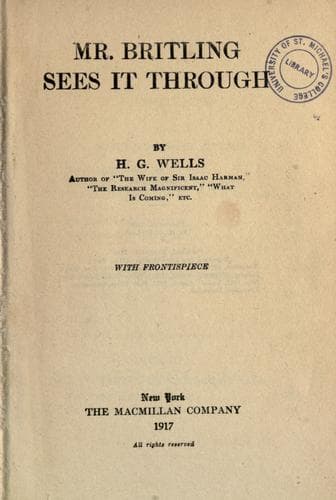
Mr. Britling Sees It ThroughWells, H. G. (Herbert George)
General
Mr. Britling Sees It Through
Wells, H. G. (Herbert George)
War stories; World War, 1914-1918 -- Fiction
Mr. Britling ignored this personal application.
"What is far more serious than a food shortage is the possibility of a
money panic."
He paced the lawn with her and talked. He said that even now very few
people realised the flimsiness of the credit system by which the modern
world was sustained. It was a huge growth of confidence, due very
largely to the uninquiring indolence of--everybody. It was sound so long
as mankind did, on the whole, believe in it; give only a sufficient loss
of faith and it might suffer any sort of collapse. It might vanish
altogether--as the credit system vanished at the breaking up of Italy by
the Goths--and leave us nothing but tangible things, real property,
possession nine points of the law, and that sort of thing. Did she
remember that last novel of Gissing's?--"Veranilda," it was called. It
was a picture of the world when there was no wealth at all except what
one could carry hidden or guarded about with one. That sort of thing
came to the Roman Empire slowly, in the course of lifetimes, but
nowadays we lived in a rapider world--with flimsier institutions. Nobody
knew the strength or the weakness of credit; nobody knew whether even
the present shock might not send it smashing down.... And then all the
little life we had lived so far would roll away....
Mrs. Britling, he noted, glanced ever and again at her sunlit
house--there were new sunblinds, and she had been happy in her choice of
a colour--and listened with a sceptical expression to this
disquisition.
"A few days ago," said Mr. Britling, trying to make things concrete for
her, "you and I together were worth five-and-twenty thousand pounds. Now
we don't know what we are worth; whether we have lost a thousand or ten
thousand...."
He examined his sovereign purse and announced he had six pounds. "What
have you?"
She had about eighteen pounds in the house.
"We may have to get along with that for an indefinite time."
"But the bank will open again presently," she said. "And people about
here trust us."
"Suppose they don't?"
She did not trouble about the hypothesis. "And our investments will
recover. They always do recover."
"Everything may recover," he admitted. "But also nothing may recover.
All this life of ours which has seemed so settled and secure--isn't
secure. I have felt that we were fixed here and rooted--for all our
lives. Suppose presently things sweep us out of it? It's a possibility
we may have to face. I feel this morning as if two enormous gates had
opened in our lives, like the gates that give upon an arena, gates
giving on a darkness--through which anything might come. Even death.
Suppose suddenly we were to see one of those great Zeppelins in the air,
or hear the thunder of guns away towards the coast. And if a messenger
came upon a bicycle telling us to leave everything and go inland...."
"I see no reason why one should go out to meet things like that."
"But there is no reason why one should not envisage them...."
Public-domain text, read in full here on John Shaqi.
Reviews
Reviews
No reviews yet
Be the first to share your thoughts on this work.
Elsewhere in the archive
Join the Discussion
Join the discussion
Sign in to leave a comment or review.
Sign InorCreate an account