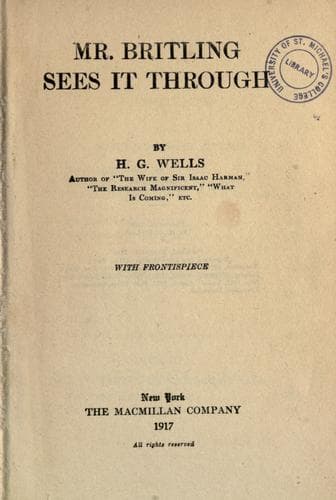
Mr. Britling Sees It ThroughWells, H. G. (Herbert George)
General
Mr. Britling Sees It Through
Wells, H. G. (Herbert George)
War stories; World War, 1914-1918 -- Fiction
Mr. Britling dwelt upon this idea of the specialised character of the
British army and navy and government. It seemed to him to be the clue to
everything that was jarring in the London spectacle. The army had been a
thing aloof, for a special end. It had developed all the characteristics
of a caste. It had very high standards along the lines of its
specialisation, but it was inadaptable and conservative. Its
exclusiveness was not so much a deliberate culture as a consequence of
its detached function. It touched the ordinary social body chiefly
through three other specialised bodies, the court, the church, and the
stage. Apart from that it saw the great unofficial civilian world as
something vague, something unsympathetic, something possibly
antagonistic, which it comforted itself by snubbing when it dared and
tricking when it could, something that projected members of Parliament
towards it and was stingy about money. Directly one grasped how apart
the army lived from the ordinary life of the community, from
industrialism or from economic necessities, directly one understood that
the great mass of Englishmen were simply "outsiders" to the War Office
mind, just as they were "outsiders" to the political clique, one began
to realise the complete unfitness of either government or War Office for
the conduct of so great a national effort as was now needed. These
people "up there" did not know anything of the broad mass of English
life at all, they did not know how or where things were made; when they
wanted things they just went to a shop somewhere and got them. This was
the necessary psychology of a small army under a clique government.
Nothing else was to be expected. But now--somehow--the nation had to
take hold of the government that it had neglected so long....
"You see," said Mr. Britling, repeating a phrase that was becoming more
and more essential to his thoughts, "this is _our_ war....
"Of course," said Mr. Britling, "these things are not going to be done
without a conflict. We aren't going to take hold of our country which we
have neglected so long without a lot of internal friction. But in
England we can make these readjustments without revolution. It is our
strength....
"At present England is confused--but it's a healthy confusion. It's
astir. We have more things to defeat than just Germany....
"These hosts of recruits--weary, uncared for, besieging the recruiting
stations. It's symbolical.... Our tremendous reserves of will and
manhood. Our almost incredible insufficiency of direction....
"Those people up there have no idea of the Will that surges up in
England. They are timid little manoeuvring people, afraid of property,
afraid of newspapers, afraid of trade-unions. They aren't leading us
against the Germans; they are just being shoved against the Germans by
necessity...."
Public-domain text, read in full here on John Shaqi.
Reviews
Reviews
No reviews yet
Be the first to share your thoughts on this work.
Elsewhere in the archive
Join the Discussion
Join the discussion
Sign in to leave a comment or review.
Sign InorCreate an account