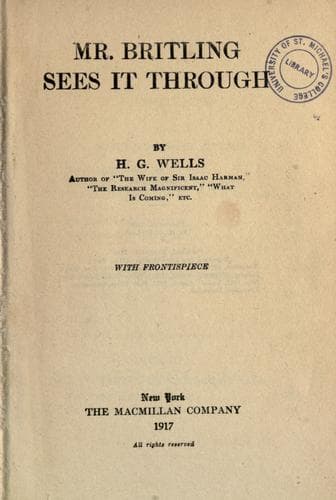
Mr. Britling Sees It ThroughWells, H. G. (Herbert George)
General
Mr. Britling Sees It Through
Wells, H. G. (Herbert George)
War stories; World War, 1914-1918 -- Fiction
From this Mr. Britling broke away into a fresh addition to his already
large collection of contrasts between England and Germany. Germany was a
nation which has been swallowed up and incorporated by an army and an
administration; the Prussian military system had assimilated to itself
the whole German life. It was a State in a state of repletion, a State
that had swallowed all its people. Britain was not a State. It was an
unincorporated people. The British army, the British War Office, and the
British administration had assimilated nothing; they were little old
partial things; the British nation lay outside them, beyond their
understanding and tradition; a formless new thing, but a great thing;
and now this British nation, this real nation, the "outsiders," had to
take up arms. Suddenly all the underlying ideas of that outer, greater
English life beyond politics, beyond the services, were challenged, its
tolerant good humour, its freedom, and its irresponsibility. It was not
simply English life that was threatened; it was all the latitudes of
democracy, it was every liberal idea and every liberty. It was
civilisation in danger. The uncharted liberal system had been taken by
the throat; it had to "make good" or perish....
"I went up to London expecting to be told what to do. There is no one to
tell any one what to do.... Much less is there any one to compel us what
to do....
"There's a War Office like a college during a riot, with its doors and
windows barred; there's a government like a cockle boat in an Atlantic
gale....
"One feels the thing ought to have come upon us like the sound of a
trumpet. Instead, until now, it has been like a great noise, that we
just listened to, in the next house.... And now slowly the nation
awakes. London is just like a dazed sleeper waking up out of a deep
sleep to fire and danger, tumult and cries for help, near at hand. The
streets give you exactly that effect. People are looking about and
listening. One feels that at any moment, in a pause, in a silence, there
may come, from far away, over the houses, faint and little, the boom of
guns or the small outcries of little French or Belgian villages in
agony...."
Such was the gist of Mr. Britling's discourse.
He did most of the table talk, and all that mattered. Teddy was an
assenting voice, Hugh was silent and apparently a little inattentive,
Mrs. Britling was thinking of the courses and the servants and the boys,
and giving her husband only half an ear, Captain Carmine said little and
seemed to be troubled by some disagreeable preoccupation. Now and then
he would endorse or supplement the things Mr. Britling was saying.
Thrice he remarked: "People still do not begin to understand."...
Public-domain text, read in full here on John Shaqi.
Reviews
Reviews
No reviews yet
Be the first to share your thoughts on this work.
Elsewhere in the archive
Join the Discussion
Join the discussion
Sign in to leave a comment or review.
Sign InorCreate an account