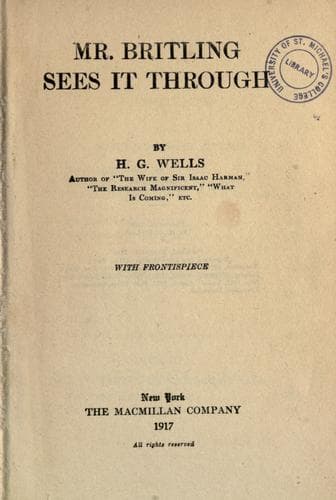
Mr. Britling Sees It ThroughWells, H. G. (Herbert George)
General
Mr. Britling Sees It Through
Wells, H. G. (Herbert George)
War stories; World War, 1914-1918 -- Fiction
When he had gone, the craving for a personal share in the nation's
physical exertions became overpowering in Mr. Britling. He wanted, he
felt, to "get his skin into it." He had decided that the volunteer
movement was a hopeless one. The War Office, after a stout resistance to
any volunteer movement at all, decided to recognise it in such a manner
as to make it ridiculous. The volunteers were to have no officers and no
uniforms that could be remotely mistaken for those of the regulars, so
that in the event of an invasion the Germans would be able to tell what
they had to deal with miles away. Wilkins found his conception of a
whole nation, all enrolled, all listed and badged according to capacity,
his dream of every one falling into place in one great voluntary
national effort, treated as the childish dreaming of that most ignorant
of all human types, a "novelist." _Punch_ was delicately funny about
him; he was represented as wearing a preposterous cocked hat of his own
design, designing cocked hats for every one. Wilkins was told to "shut
up" in a multitude of anonymous letters, and publicly and privately to
"leave things to Kitchener." To bellow in loud clear tones "leave things
to Kitchener," and to depart for the theatre or the river or an
automobile tour, was felt very generally at that time to be the proper
conduct for a patriot. There was a very general persuasion that to
become a volunteer when one ought to be just modestly doing nothing at
all, was in some obscure way a form of disloyalty....
So Mr. Britling was out of conceit with volunteering, and instead he
went and was duly sworn and entrusted with the badge of a special
constable. The duties of a special constable were chiefly not to
understand what was going on in the military sphere, and to do what he
was told in the way of watching and warding conceivably vulnerable
points. He had also to be available in the event of civil disorder. Mr.
Britling was provided with a truncheon and sent out to guard various
culverts, bridges, and fords in the hilly country to the north-westward
of Matching's Easy. It was never very clear to him what he would do if
he found a motor-car full of armed enemies engaged in undermining a
culvert, or treacherously deepening some strategic ford. He supposed he
would either engage them in conversation, or hit them with his
truncheon, or perhaps do both things simultaneously. But as he really
did not believe for a moment that any human being was likely to tamper
with the telegraphs, telephones, ways and appliances committed to his
care, his uncertainty did not trouble him very much. He prowled the
lonely lanes and paths in the darkness, and became better acquainted
with a multitude of intriguing little cries and noises that came from
the hedges and coverts at night. One night he rescued a young leveret
from a stoat, who seemed more than half inclined to give him battle for
its prey until he cowed and defeated it with the glare of his electric
torch....
Public-domain text, read in full here on John Shaqi.
Reviews
Reviews
No reviews yet
Be the first to share your thoughts on this work.
Elsewhere in the archive
Join the Discussion
Join the discussion
Sign in to leave a comment or review.
Sign InorCreate an account