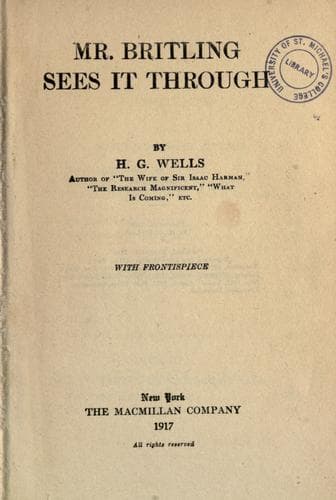
Mr. Britling Sees It ThroughWells, H. G. (Herbert George)
General
Mr. Britling Sees It Through
Wells, H. G. (Herbert George)
War stories; World War, 1914-1918 -- Fiction
As he prowled the countryside under the great hemisphere of Essex sky,
or leant against fences or sat drowsily upon gates or sheltered from
wind and rain under ricks or sheds, he had much time for meditation, and
his thoughts went down and down below his first surface impressions of
the war. He thought no longer of the rights and wrongs of this
particular conflict but of the underlying forces in mankind that made
war possible; he planned no more ingenious treaties and conventions
between the nations, and instead he faced the deeper riddles of
essential evil and of conceivable changes in the heart of man. And the
rain assailed him and thorns tore him, and the soaked soft meadows
bogged and betrayed his wandering feet, and the little underworld of the
hedges and ditches hissed and squealed in the darkness and pursued and
fled, and devoured or were slain.
And one night in April he was perplexed by a commotion among the
pheasants and a barking of distant dogs, and then to his great
astonishment he heard noises like a distant firework display and saw
something like a phantom yellowish fountain-pen in the sky far away to
the east lit intermittently by a quivering search-light and going very
swiftly. And after he had rubbed his eyes and looked again, he realised
that he was looking at a Zeppelin--a Zeppelin flying Londonward over
Essex.
And all that night was wonder....
Section 8
While Mr. Britling was trying to find his duty in the routine of a
special constable, Mrs. Britling set to work with great energy to attend
various classes and qualify herself for Red Cross work. And early in
October came the great drive of the Germans towards Antwerp and the sea,
the great drive that was apparently designed to reach Calais, and which
swept before it multitudes of Flemish refugees. There was an exodus of
all classes from Antwerp into Holland and England, and then a huge
process of depopulation in Flanders and the Pas de Calais. This flood
came to the eastern and southern parts of England and particularly to
London, and there hastily improvised organisations distributed it to a
number of local committees, each of which took a share of the refugees,
hired and furnished unoccupied houses for the use of the penniless, and
assisted those who had means into comfortable quarters. The Matching's
Easy committee found itself with accommodation for sixty people, and
with a miscellaneous bag of thirty individuals entrusted to its care,
who had been part of the load of a little pirate steam-boat from Ostend.
There were two Flemish peasant families, and the rest were more or less
middle-class refugees from Antwerp. They were brought from the station
to the Tithe barn at Claverings, and there distributed, under the
personal supervision of Lady Homartyn and her agent, among those who
were prepared for their entertainment. There was something like
competition among the would-be hosts; everybody was glad of the chance
Public-domain text, read in full here on John Shaqi.
Reviews
Reviews
No reviews yet
Be the first to share your thoughts on this work.
Elsewhere in the archive
Join the Discussion
Join the discussion
Sign in to leave a comment or review.
Sign InorCreate an account